Pearson+ LogoPearson+ Logo
Ch.9 Solutions
McMurry - Fundamentals of GOB 8th Edition
McMurry8th EditionFundamentals of GOBISBN: 9780134015187Not the one you use?Change textbook
Chapter 9, Problem 11

The maximum amounts of lead and copper allowed in drinking water are 0.015 mg/kg for lead and 1.3 mg/kg for copper. Express these values in parts per million, and tell the maximum amount of each (in grams) allowed in 100 g of water.

Verified step by step guidance
1
Step 1: Understand the relationship between parts per million (ppm) and mg/kg. Since 1 ppm is equivalent to 1 mg of solute per 1 kg of solution, the given values for lead (0.015 mg/kg) and copper (1.3 mg/kg) are already expressed in ppm. Therefore, lead is 0.015 ppm, and copper is 1.3 ppm.
Step 2: To find the maximum amount of lead allowed in 100 g of water, first convert the mass of water from grams to kilograms. Since 1 kg = 1000 g, 100 g of water is equivalent to 0.1 kg.
Step 3: Use the concentration of lead in ppm (0.015 ppm) to calculate the mass of lead in 0.1 kg of water. Multiply the concentration (in mg/kg) by the mass of water (in kg): \( \text{Mass of lead} = 0.015 \text{ mg/kg} \times 0.1 \text{ kg} \).
Step 4: Similarly, calculate the maximum amount of copper allowed in 100 g of water. Use the concentration of copper in ppm (1.3 ppm) and multiply it by the mass of water (in kg): \( \text{Mass of copper} = 1.3 \text{ mg/kg} \times 0.1 \text{ kg} \).
Step 5: Convert the calculated masses of lead and copper from milligrams to grams. Since 1 mg = 0.001 g, divide the results from Steps 3 and 4 by 1000 to express the masses in grams.

Verified video answer for a similar problem:

This video solution was recommended by our tutors as helpful for the problem above.
Video duration:
4m
Was this helpful?

Key Concepts

Here are the essential concepts you must grasp in order to answer the question correctly.

Parts Per Million (PPM)

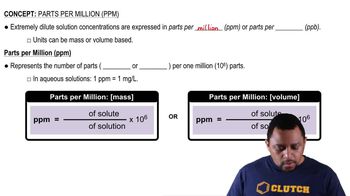
Parts per million (PPM) is a unit of measurement used to describe the concentration of a substance in a solution. It indicates how many parts of a substance are present in one million parts of the total solution. For example, 1 PPM means 1 milligram of a substance in 1 liter of water, which is equivalent to 1 mg/kg in terms of concentration.
Recommended video:
Guided course
01:38
Parts per Million (ppm) Concept 1

Conversion from mg/kg to PPM

The conversion from milligrams per kilogram (mg/kg) to parts per million (PPM) is straightforward, as 1 mg/kg is equal to 1 PPM. This equivalence arises because 1 kilogram of water is approximately equal to 1 liter, making the two units interchangeable in the context of water solutions.
Recommended video:
Guided course
01:38
Parts per Million (ppm) Concept 1

Calculating Maximum Allowable Amounts

To find the maximum allowable amounts of lead and copper in grams for a specific volume of water, you can use the concentration values in PPM. For 100 g of water, you multiply the concentration (in PPM) by the mass of the water (in grams) and then convert from milligrams to grams, as there are 1000 mg in a gram.
Recommended video:
Guided course
01:10
Calculating Molar Mass