Pearson+ LogoPearson+ Logo
Ch.12 Introduction to Organic Chemistry: Alkanes
McMurry - Fundamentals of GOB 8th Edition
McMurry8th EditionFundamentals of GOBISBN: 9780134015187Not the one you use?Change textbook
Chapter 12, Problem 55c

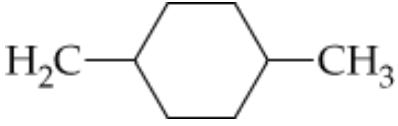
Name the following cycloalkanes:
c. Structural formula of a cycloalkane with a hexagonal ring and two carbon substituents, one with a methyl group.

Verified step by step guidance
1
Identify the number of carbon atoms in the ring structure of the cycloalkane. The number of carbons determines the base name of the compound (e.g., cyclopropane for 3 carbons, cyclobutane for 4 carbons, etc.).
Check for any substituents (groups attached to the ring) and identify their type (e.g., methyl, ethyl, etc.) and position on the ring. Number the ring carbons starting from the substituent that gives the lowest possible numbering.
If there are multiple substituents, list them in alphabetical order in the name, and use prefixes like di-, tri-, etc., if the same substituent appears more than once.
Combine the substituent names with the base name of the cycloalkane. Use hyphens to separate numbers from words and commas to separate numbers.
Ensure the final name follows IUPAC naming conventions, including proper punctuation and formatting.

Verified video answer for a similar problem:

This video solution was recommended by our tutors as helpful for the problem above.
Was this helpful?

Key Concepts

Here are the essential concepts you must grasp in order to answer the question correctly.

Cycloalkanes

Cycloalkanes are a class of hydrocarbons characterized by carbon atoms arranged in a ring structure. They are saturated compounds, meaning they contain only single bonds between carbon atoms. The general formula for cycloalkanes is CnH2n, where n is the number of carbon atoms. Understanding their structure is essential for naming and identifying different cycloalkanes.
Recommended video:
Guided course
0:36
Rules for Naming Cyclic Alkanes Concept 1

Nomenclature

Nomenclature refers to the systematic naming of chemical compounds according to established rules. For cycloalkanes, the naming convention typically involves identifying the number of carbon atoms in the ring and using prefixes like 'cyclo-' followed by the appropriate alkane name. Familiarity with IUPAC (International Union of Pure and Applied Chemistry) rules is crucial for accurately naming these compounds.
Recommended video:
Guided course
2:39
Rules for Naming Alkanes Concept 1

Isomerism

Isomerism is the phenomenon where compounds with the same molecular formula can have different structural arrangements or spatial orientations. In cycloalkanes, isomers can arise from variations in the arrangement of carbon atoms or the presence of substituents on the ring. Recognizing isomers is important for understanding the diversity of cycloalkane structures and their corresponding names.
Recommended video:
Guided course
1:26
Glycolysis Concept 5