Pearson+ LogoPearson+ Logo
Ch.12 Introduction to Organic Chemistry: Alkanes
McMurry - Fundamentals of GOB 8th Edition
McMurry8th EditionFundamentals of GOBISBN: 9780134015187Not the one you use?Change textbook
Chapter 12, Problem 52d

Write condensed structures for the following compounds:
d. 3-Ethyl-1-isopropyl-5-methylcycloheptane

Verified step by step guidance
1
Identify the parent chain: The parent chain is 'cycloheptane,' which is a seven-membered ring structure. This will serve as the base structure for the compound.
Locate and number the substituents: Start numbering the cycloheptane ring from the position that gives the substituents the lowest possible numbers. In this case, the substituents are located at positions 1, 3, and 5.
Add the substituents: At position 1, there is an isopropyl group (a branched group with the structure CH(CH3)2). At position 3, there is an ethyl group (CH2CH3). At position 5, there is a methyl group (CH3).
Write the condensed structure: Begin with the cycloheptane ring and attach the substituents at their respective positions. Use parentheses to indicate branching where necessary. For example, the isopropyl group at position 1 can be written as CH(CH3)2.
Combine all components: The final condensed structure will include the cycloheptane ring with the substituents properly placed and written in condensed form. Ensure the structure reflects the correct connectivity and branching as described in the name.

Verified video answer for a similar problem:

This video solution was recommended by our tutors as helpful for the problem above.
Was this helpful?

Key Concepts

Here are the essential concepts you must grasp in order to answer the question correctly.

Condensed Structures

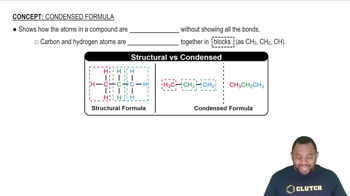
Condensed structures are a simplified way of representing molecular structures that show the connectivity of atoms without depicting all the bonds explicitly. In these structures, groups of atoms are often grouped together to reflect their connectivity, making it easier to visualize the overall structure of the compound. This format is particularly useful for organic compounds, where complex branching and functional groups can be represented succinctly.
Recommended video:
Guided course
1:53
Condensed Formula Concept 1

Cycloalkanes

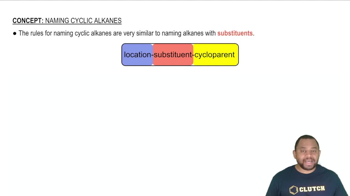
Cycloalkanes are a class of hydrocarbons characterized by carbon atoms arranged in a ring structure. They are saturated compounds, meaning they contain only single bonds between carbon atoms. The naming of cycloalkanes follows specific IUPAC rules, where the prefix 'cyclo-' indicates the cyclic nature, and the longest carbon chain is used to determine the base name, which is crucial for understanding the structure of compounds like cycloheptane.
Recommended video:
Guided course
0:36
Rules for Naming Cyclic Alkanes Concept 1

IUPAC Nomenclature

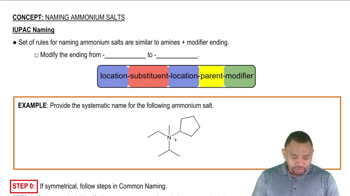
IUPAC nomenclature is a systematic method for naming chemical compounds, ensuring that each compound has a unique and descriptive name. It involves identifying the longest carbon chain, determining the functional groups, and assigning locants to indicate the position of substituents. Understanding IUPAC rules is essential for accurately interpreting and constructing the names of organic compounds, such as 3-Ethyl-1-isopropyl-5-methylcycloheptane, which reflects its structure and substituents.
Recommended video:
Guided course
3:18
IUPAC Naming Concept 3