Pearson+ LogoPearson+ Logo
Ch.13 Alkenes, Alkynes, and Aromatic Compounds
McMurry - Fundamentals of GOB 8th Edition
McMurry8th EditionFundamentals of GOBISBN: 9780134015187Not the one you use?Change textbook
Chapter 13, Problem 28

Alkynes undergo hydrogenation to give alkanes, just as alkenes do. Draw and name the products that would result from hydrogenation of the alkynes shown in Problem 13.25.
<IMAGE>

Verified step by step guidance
1
Identify the alkyne structure provided in Problem 13.25. Alkynes are hydrocarbons containing at least one carbon-carbon triple bond (C≡C). For this problem, we will assume a generic alkyne structure if the specific one is not provided.
Understand the process of hydrogenation. Hydrogenation involves the addition of hydrogen (H₂) across the multiple bonds in the presence of a catalyst, such as palladium (Pd), platinum (Pt), or nickel (Ni). For alkynes, this process converts the triple bond (C≡C) into a single bond (C-C), forming an alkane.
Write the balanced chemical equation for the hydrogenation reaction. For example, if the alkyne is ethyne (C₂H₂), the reaction would be: C2H2 + 2H2C2H6
Determine the name of the product. The IUPAC naming system is used to name the resulting alkane. For example, if the alkyne is ethyne, the product of hydrogenation is ethane. If the alkyne is propyne, the product is propane.
Draw the structure of the product. Replace the triple bond in the alkyne with single bonds, ensuring that each carbon atom has four bonds in total. Add the appropriate number of hydrogen atoms to satisfy the valency of each carbon atom.

Verified video answer for a similar problem:

This video solution was recommended by our tutors as helpful for the problem above.
Was this helpful?

Key Concepts

Here are the essential concepts you must grasp in order to answer the question correctly.

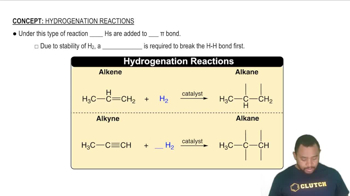
Hydrogenation

Hydrogenation is a chemical reaction that involves the addition of hydrogen (H2) to an unsaturated compound, such as alkenes or alkynes, resulting in the formation of saturated compounds. In the case of alkynes, hydrogenation can lead to the formation of alkenes or alkanes, depending on the extent of hydrogen addition. This process is typically facilitated by catalysts like palladium, platinum, or nickel.
Recommended video:
Guided course
1:22
Hydrogenation Reactions Concept 1

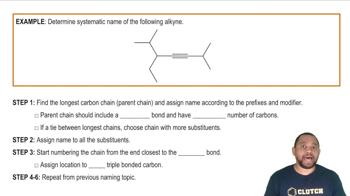
Alkynes

Alkynes are a class of hydrocarbons characterized by at least one carbon-carbon triple bond (C≡C). They are unsaturated compounds and have the general formula CnH2n-2. Alkynes can undergo various chemical reactions, including hydrogenation, which transforms them into alkenes or alkanes, thereby altering their physical and chemical properties.
Recommended video:
Guided course
4:11
Naming Alkynes Example 1

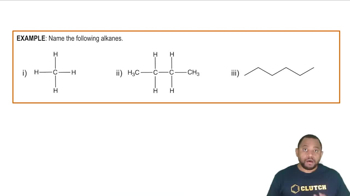
Alkanes

Alkanes are saturated hydrocarbons that contain only single carbon-carbon bonds, with the general formula CnH2n+2. They are typically less reactive than alkenes and alkynes due to the absence of double or triple bonds. The hydrogenation of alkynes results in the formation of alkanes, which are often used as fuels and in various chemical applications due to their stability.
Recommended video:
Guided course
1:20
Naming Alkanes Example 1