
Pearson+ LogoPearson+ Logo
Ch.13 Alkenes, Alkynes, and Aromatic Compounds
McMurry - Fundamentals of GOB 8th Edition
McMurry8th EditionFundamentals of GOBISBN: 9780134015187Not the one you use?Change textbook
Chapter 13, Problem 72

Assume that you have two unlabeled bottles, one with cyclohexane and one with cyclohexene. How could you tell them apart by carrying out chemical reactions?

Verified step by step guidance
1
Step 1: Understand the chemical difference between cyclohexane and cyclohexene. Cyclohexane is a saturated hydrocarbon (an alkane), while cyclohexene is an unsaturated hydrocarbon (an alkene) containing a double bond. This double bond in cyclohexene makes it chemically reactive in ways that cyclohexane is not.
Step 2: Use a bromine test to distinguish between the two. Bromine ( Br 2 ) reacts with alkenes but not with alkanes. Add a small amount of bromine solution (reddish-brown in color) to each bottle. If the solution becomes colorless, it indicates the presence of an alkene (cyclohexene). If the color remains, it indicates the presence of an alkane (cyclohexane).
Step 3: Perform a potassium permanganate test (Baeyer's test). Potassium permanganate ( KMnO 4 ) reacts with alkenes to form a diol, resulting in the decolorization of the purple solution and the formation of a brown precipitate (manganese dioxide). Add a dilute solution of potassium permanganate to each bottle. If the purple color disappears and a brown precipitate forms, it indicates the presence of an alkene (cyclohexene). If no reaction occurs, it indicates the presence of an alkane (cyclohexane).
Step 4: Confirm the results by repeating the tests if necessary. Ensure that the observations are consistent for each bottle to accurately identify which one contains cyclohexane and which one contains cyclohexene.
Step 5: Label the bottles based on the results of the tests. The bottle that reacts with bromine and potassium permanganate contains cyclohexene, while the bottle that does not react contains cyclohexane.

Verified video answer for a similar problem:

This video solution was recommended by our tutors as helpful for the problem above.
Was this helpful?

Key Concepts

Here are the essential concepts you must grasp in order to answer the question correctly.

Cyclohexane vs. Cyclohexene

Cyclohexane is a saturated hydrocarbon (alkane) with the formula C6H12, while cyclohexene is an unsaturated hydrocarbon (alkene) with the formula C6H10. The key difference lies in the presence of a double bond in cyclohexene, which makes it more reactive than cyclohexane. Understanding these structural differences is crucial for identifying the compounds through chemical reactions.
Recommended video:
Guided course
3:33
Enantiomers vs Diastereomers Concept 1

Electrophilic Addition Reactions

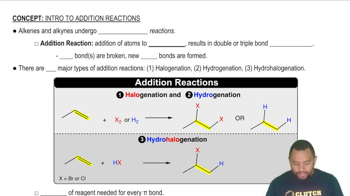
Cyclohexene can undergo electrophilic addition reactions due to its double bond, allowing it to react with reagents like bromine or hydrogen halides. In contrast, cyclohexane, being saturated, does not participate in such reactions. By adding bromine water, for example, cyclohexene will decolorize the solution, while cyclohexane will not show any change, providing a clear method for differentiation.
Recommended video:
Guided course
2:55
Addition Reactions Concept 1

Oxidation Reactions

Cyclohexene can be oxidized to form diols or other products, while cyclohexane is relatively inert to oxidation under mild conditions. A common test involves using potassium permanganate (KMnO4), which will oxidize cyclohexene, resulting in a color change from purple to brown due to the formation of manganese dioxide. This reaction can serve as a distinguishing test between the two compounds.
Recommended video:
Guided course
1:32
Alcohol Reactions Oxidation Reactions Example 1