
Pearson+ LogoPearson+ Logo
Ch.13 Alkenes, Alkynes, and Aromatic Compounds
McMurry - Fundamentals of GOB 8th Edition
McMurry8th EditionFundamentals of GOBISBN: 9780134015187Not the one you use?Change textbook
Chapter 13, Problem 76

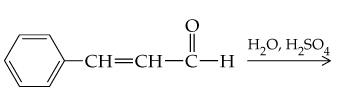
Cinnamaldehyde, the pleasant-smelling substance found in cinnamon oil, has the following structure:

What products would you expect to obtain from reaction of cinnamaldehyde with water and sulfuric acid catalyst?

Verified step by step guidance
1
Identify the functional groups in cinnamaldehyde. The molecule contains an aldehyde group (-CHO) and a conjugated double bond system (C=C). These groups are reactive under acidic conditions.
Understand the reaction type. The reaction involves water and a sulfuric acid catalyst, which suggests a hydration reaction. In this case, the double bond in the conjugated system is likely to undergo electrophilic addition of water.
Protonate the double bond. Under acidic conditions, the sulfuric acid donates a proton (H⁺) to one of the carbons in the double bond, creating a carbocation intermediate. The stability of the carbocation is enhanced by resonance with the aldehyde group.
Add water to the carbocation. A water molecule acts as a nucleophile and attacks the positively charged carbon in the carbocation, forming a new bond and resulting in a protonated alcohol intermediate.
Deprotonate the intermediate. A base (such as water or bisulfate ion) removes the extra proton from the protonated alcohol, yielding the final product: a hydroxyl group (-OH) added to the carbon that was part of the double bond, forming a beta-hydroxy aldehyde.

Verified video answer for a similar problem:

This video solution was recommended by our tutors as helpful for the problem above.
Was this helpful?

Key Concepts

Here are the essential concepts you must grasp in order to answer the question correctly.

Cinnamaldehyde Structure and Reactivity

Cinnamaldehyde is an organic compound characterized by its aldehyde functional group and a phenyl ring. Its structure allows it to undergo various chemical reactions, particularly nucleophilic addition reactions, where water can act as a nucleophile. Understanding its structure is crucial for predicting the products formed during reactions.
Recommended video:
Guided course
1:01
Structural Formula Concept 2

Hydration Reaction

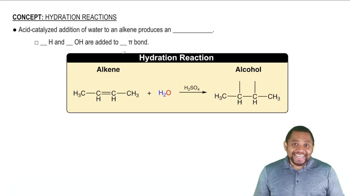
The hydration reaction involves the addition of water to a compound, typically resulting in the formation of an alcohol. In the presence of a catalyst like sulfuric acid, the reaction can proceed more efficiently. This concept is essential for predicting the products when cinnamaldehyde reacts with water.
Recommended video:
Guided course
1:25
Symmetric Alkene Hydration Concept 1

Role of Sulfuric Acid as a Catalyst

Sulfuric acid serves as a strong acid catalyst that can enhance the rate of chemical reactions, including hydration. It helps to protonate the carbonyl oxygen of cinnamaldehyde, making the carbonyl carbon more electrophilic and facilitating the addition of water. Understanding its catalytic role is vital for anticipating the reaction pathway and products.
Recommended video: