Pearson+ LogoPearson+ Logo
Ch.14 Some Compounds with Oxygen, Sulfur, or a Halogen
McMurry - Fundamentals of GOB 8th Edition
McMurry8th EditionFundamentals of GOBISBN: 9780134015187Not the one you use?Change textbook
Chapter 14, Problem 59d

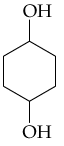
Are the following molecules chiral or achiral? If they are chiral, identify the chiral carbon atom(s).
d. Chemical structure of a hexagonal ring with two hydroxyl (OH) groups, questioning chirality and identifying chiral carbons.

Verified step by step guidance
1
Step 1: Understand the concept of chirality. A molecule is chiral if it cannot be superimposed on its mirror image. This typically occurs when a carbon atom is bonded to four different groups.
Step 2: Examine the structure of the molecule provided in the image. Identify all carbon atoms and check if each carbon is bonded to four distinct groups.
Step 3: For each carbon atom, verify the groups attached. If a carbon atom has four different substituents, it is a chiral center.
Step 4: If the molecule contains one or more chiral centers, it is chiral. If no chiral centers are present, the molecule is achiral.
Step 5: Mark the chiral carbon atom(s) on the structure provided in the image, if applicable, and confirm the molecule's chirality status.

Verified video answer for a similar problem:

This video solution was recommended by our tutors as helpful for the problem above.
Video duration:
1m
Was this helpful?

Key Concepts

Here are the essential concepts you must grasp in order to answer the question correctly.

Chirality

Chirality is a property of a molecule that indicates it cannot be superimposed on its mirror image. This occurs when a carbon atom is bonded to four different substituents, creating non-superimposable mirror images known as enantiomers. Chirality is crucial in many biological processes and can affect the behavior of molecules in chemical reactions.
Recommended video:
Guided course
1:39
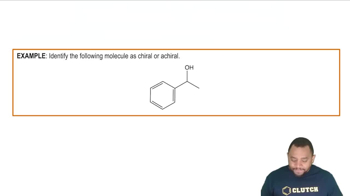
Chirality Example 1

Chiral Carbon Atom

A chiral carbon atom, also known as a stereocenter, is a carbon atom that is attached to four different groups or atoms. The presence of such a carbon in a molecule is what makes it chiral. Identifying chiral carbon atoms is essential for determining the chirality of the entire molecule and understanding its stereochemistry.
Recommended video:
Guided course
2:37
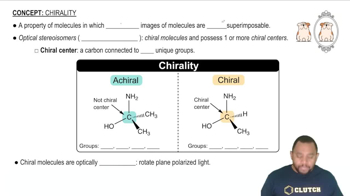
Chirality Concept 1

Achirality

Achirality refers to molecules that are superimposable on their mirror images, meaning they do not have chiral centers. These molecules can have symmetrical structures or may contain identical substituents on the carbon atoms. Understanding achirality is important for distinguishing between chiral and achiral compounds in stereochemical analysis.
Recommended video:
Guided course
2:37
Chirality Concept 1