Pearson+ LogoPearson+ Logo
Ch.14 Some Compounds with Oxygen, Sulfur, or a Halogen
McMurry - Fundamentals of GOB 8th Edition
McMurry8th EditionFundamentals of GOBISBN: 9780134015187Not the one you use?Change textbook
Chapter 14, Problem 60

Name all unbranched ether and alcohol isomers with formula C5H12O and write their structural formulas.

Verified step by step guidance
1
Step 1: Understand the molecular formula C5H12O. This formula indicates that the compound contains 5 carbon atoms, 12 hydrogen atoms, and 1 oxygen atom. The oxygen atom can be part of either an alcohol (-OH group) or an ether (C-O-C group).
Step 2: Begin with alcohol isomers. Alcohols have the functional group -OH attached to a carbon chain. Start by arranging the 5 carbon atoms in a straight chain (pentanol) and systematically move the -OH group to different positions along the chain to create positional isomers.
Step 3: Next, consider branching possibilities for alcohols. Rearrange the carbon chain to form shorter chains with branches (e.g., isopropyl or tert-butyl groups) while ensuring the -OH group is still present. Write the structural formulas for each configuration.
Step 4: Move on to ether isomers. Ethers have the functional group C-O-C. Start by arranging the 5 carbon atoms in a straight chain and place the oxygen atom between two carbons. Then, systematically rearrange the carbon chain to form different ether isomers, including branched configurations.
Step 5: Verify that each structure adheres to the molecular formula C5H12O and does not duplicate any previously identified isomers. Write the structural formulas for all unique unbranched ether and alcohol isomers.

Verified video answer for a similar problem:

This video solution was recommended by our tutors as helpful for the problem above.
Was this helpful?

Key Concepts

Here are the essential concepts you must grasp in order to answer the question correctly.

Isomerism

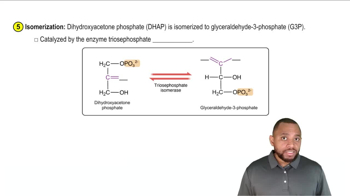
Isomerism refers to the phenomenon where two or more compounds have the same molecular formula but different structural arrangements or spatial orientations of atoms. In the case of C5H12O, isomers can be classified into structural isomers, which differ in the connectivity of atoms, and stereoisomers, which differ in the spatial arrangement of atoms. Understanding isomerism is crucial for identifying and naming the various ether and alcohol isomers of a given molecular formula.
Recommended video:
Guided course
1:26
Glycolysis Concept 5

Ethers and Alcohols

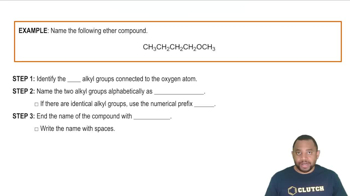
Ethers and alcohols are two classes of organic compounds characterized by the presence of oxygen. Alcohols contain a hydroxyl (-OH) group attached to a carbon atom, while ethers have an oxygen atom connected to two alkyl or aryl groups. The distinction between these two types of compounds is essential when identifying isomers of C5H12O, as it determines the functional groups present and influences their chemical properties and reactivity.
Recommended video:
Guided course
1:15
Naming Ethers Example 1

Structural Formulas

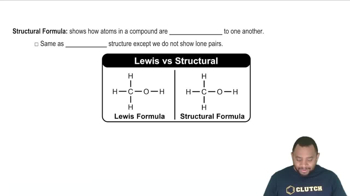
Structural formulas are representations of a molecule that show the arrangement of atoms and the bonds between them. They provide a visual understanding of how atoms are connected in a compound, which is vital for distinguishing between different isomers. For the isomers of C5H12O, drawing structural formulas helps in identifying the specific ether and alcohol isomers, facilitating a clearer comprehension of their unique properties and behaviors.
Recommended video:
Guided course
1:01
Structural Formula Concept 2