Pearson+ LogoPearson+ Logo
Ch.14 Some Compounds with Oxygen, Sulfur, or a Halogen
McMurry - Fundamentals of GOB 8th Edition
McMurry8th EditionFundamentals of GOBISBN: 9780134015187Not the one you use?Change textbook
Chapter 14, Problem 56b

Define the following terms:
b. Achiral

Verified step by step guidance
1
Step 1: Begin by understanding the concept of chirality. Chirality refers to the property of a molecule that makes it non-superimposable on its mirror image, much like how your left and right hands are mirror images but cannot be perfectly aligned.
Step 2: Define achiral. Achiral molecules are those that are superimposable on their mirror images. This means that the molecule and its mirror image are identical in all respects.
Step 3: Recognize the structural characteristics of achiral molecules. Achiral molecules often have a plane of symmetry or a center of symmetry, which allows them to be superimposable on their mirror images.
Step 4: Provide an example of an achiral molecule. For instance, methane (CH₄) is achiral because it has a tetrahedral geometry and is symmetric, making it identical to its mirror image.
Step 5: Summarize the distinction between achiral and chiral molecules. Achiral molecules lack the property of chirality and are superimposable on their mirror images, whereas chiral molecules are not superimposable and exist as enantiomers (mirror-image pairs).

Verified video answer for a similar problem:

This video solution was recommended by our tutors as helpful for the problem above.
Was this helpful?

Key Concepts

Here are the essential concepts you must grasp in order to answer the question correctly.

Chirality

Chirality is a property of asymmetry important in several branches of science, particularly in chemistry and biology. A molecule is considered chiral if it cannot be superimposed on its mirror image, much like left and right hands. This property is crucial in understanding the behavior of molecules in biological systems, as chiral molecules can have different effects based on their orientation.
Recommended video:
Guided course
1:39
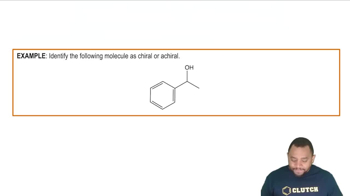
Chirality Example 1

Achirality

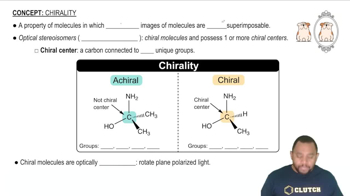
Achirality refers to the property of a molecule that is superimposable on its mirror image, meaning it does not have a chiral center. Achiral molecules can be symmetrical or possess a plane of symmetry, which allows them to be identical to their mirror images. Common examples include simple molecules like carbon dioxide (CO2) and methane (CH4), which do not exhibit chirality.
Recommended video:
Guided course
2:37
Chirality Concept 1

Stereoisomerism

Stereoisomerism is a form of isomerism where molecules have the same molecular formula and connectivity of atoms but differ in the spatial arrangement of their atoms. This concept is closely related to chirality, as chiral molecules can exist as stereoisomers known as enantiomers, which are non-superimposable mirror images. Understanding stereoisomerism is essential for grasping the implications of chirality in chemical reactions and biological interactions.
Recommended video:
Guided course
1:56
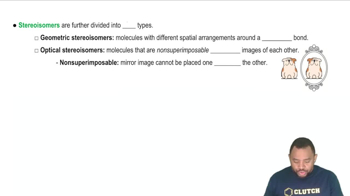
Stereoisomers Concept 2