Pearson+ LogoPearson+ Logo
Ch.14 Some Compounds with Oxygen, Sulfur, or a Halogen
McMurry - Fundamentals of GOB 8th Edition
McMurry8th EditionFundamentals of GOBISBN: 9780134015187Not the one you use?Change textbook
Chapter 14, Problem 56c

Define the following terms:
c. Chiral carbon

Verified step by step guidance
1
A chiral carbon is a carbon atom that is bonded to four different groups or atoms. This unique arrangement makes the carbon atom asymmetric, meaning it cannot be superimposed on its mirror image.
To identify a chiral carbon in a molecule, examine each carbon atom and check if it is attached to four distinct substituents. These substituents can be atoms or groups of atoms.
Chiral carbons are important in stereochemistry because they lead to the existence of enantiomers, which are non-superimposable mirror images of each other.
The presence of a chiral carbon in a molecule often results in optical activity, meaning the molecule can rotate plane-polarized light either to the right (dextrorotatory) or to the left (levorotatory).
In chemical notation, a chiral carbon is often marked with an asterisk (*) to indicate its asymmetry and importance in stereochemical discussions.

Verified video answer for a similar problem:

This video solution was recommended by our tutors as helpful for the problem above.
Was this helpful?

Key Concepts

Here are the essential concepts you must grasp in order to answer the question correctly.

Chirality

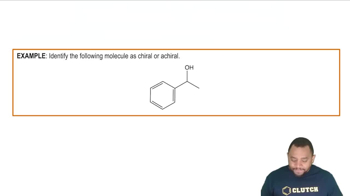
Chirality is a property of asymmetry important in several branches of science, particularly chemistry. A molecule is considered chiral if it cannot be superimposed on its mirror image, much like left and right hands. This property is crucial in the study of stereochemistry, as chiral molecules can have different biological activities and properties.
Recommended video:
Guided course
1:39
Chirality Example 1

Chiral Carbon

A chiral carbon, also known as a stereocenter, is a carbon atom that is bonded to four different substituents or groups. This unique arrangement allows for the existence of two non-superimposable mirror images, known as enantiomers. The presence of a chiral carbon in a molecule is a key factor in determining its chirality and, consequently, its chemical behavior.
Recommended video:
Guided course
1:39
Chirality Example 1

Enantiomers

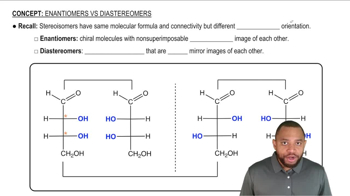
Enantiomers are pairs of chiral molecules that are mirror images of each other but cannot be superimposed. They often exhibit different physical and chemical properties, including varying interactions with polarized light and biological systems. Understanding enantiomers is essential in fields like pharmacology, where the efficacy and safety of drugs can depend on their specific chiral form.
Recommended video:
Guided course
3:33
Enantiomers vs Diastereomers Concept 1