Pearson+ LogoPearson+ Logo
Ch.14 Some Compounds with Oxygen, Sulfur, or a Halogen
McMurry - Fundamentals of GOB 8th Edition
McMurry8th EditionFundamentals of GOBISBN: 9780134015187Not the one you use?Change textbook
Chapter 14, Problem 53

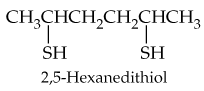
Oxidation of a dithiol such as 2,5-hexanedithiol forms a six-membered ring containing a disulfide group as part of the ring. Draw the structure of this cyclic disulfide (Hint: Draw the starting compound in line structure format first).

Verified step by step guidance
1
Start by understanding the structure of the starting compound, 2,5-hexanedithiol. This molecule consists of a six-carbon chain with thiol (-SH) groups attached to the second and fifth carbons. Draw this structure in a line structure format, where each vertex represents a carbon atom, and the thiol groups are shown as -SH.
Recognize that the oxidation of thiol groups (-SH) leads to the formation of a disulfide bond (-S-S-). In this reaction, the two sulfur atoms from the thiol groups will bond together, releasing two hydrogen atoms as part of the oxidation process.
To form the cyclic disulfide, connect the sulfur atoms from the thiol groups on the second and fifth carbons. This connection will create a six-membered ring, as the carbon chain loops back on itself to form a closed structure.
Redraw the structure to clearly show the six-membered ring. The ring will consist of four carbon atoms and two sulfur atoms, with the sulfur atoms connected by a disulfide bond (-S-S-). Ensure that all other bonds and hydrogens are correctly represented.
Double-check the structure to confirm that it satisfies the rules of valency for all atoms and that the disulfide bond is correctly incorporated into the six-membered ring. This is the final structure of the cyclic disulfide formed from the oxidation of 2,5-hexanedithiol.

Verified video answer for a similar problem:

This video solution was recommended by our tutors as helpful for the problem above.
Was this helpful?

Key Concepts

Here are the essential concepts you must grasp in order to answer the question correctly.

Dithiol Compounds

Dithiols are organic compounds containing two thiol (-SH) groups. They are important in organic chemistry for their ability to undergo oxidation, leading to the formation of disulfides. In the case of 2,5-hexanedithiol, the two thiol groups are positioned on the first and fifth carbon atoms of a six-carbon chain, which is crucial for the subsequent cyclization reaction.
Recommended video:
Guided course
02:11
Naming Ionic Compounds

Oxidation Reaction

Oxidation is a chemical reaction that involves the loss of electrons or an increase in oxidation state. In the context of dithiols, oxidation leads to the formation of disulfides, where two thiol groups react to form a covalent bond between sulfur atoms. This process is essential for creating cyclic structures, such as the six-membered ring mentioned in the question.
Recommended video:
Guided course
1:32
Alcohol Reactions Oxidation Reactions Example 1

Cyclic Disulfide Structure

A cyclic disulfide is a ring structure that contains a disulfide bond (–S–S–) as part of its framework. In the case of the oxidation of 2,5-hexanedithiol, the formation of a six-membered ring involves the two sulfur atoms from the thiol groups bonding together, resulting in a stable cyclic compound. Understanding the geometry and bonding in cyclic disulfides is key to drawing their correct structures.
Recommended video:
Guided course
2:49
Cyclic Structures of Monosaccharides Concept 1