Pearson+ LogoPearson+ Logo
Ch.14 Some Compounds with Oxygen, Sulfur, or a Halogen
McMurry - Fundamentals of GOB 8th Edition
McMurry8th EditionFundamentals of GOBISBN: 9780134015187Not the one you use?Change textbook
Chapter 14, Problem 24

The compound pictured here is a thiol. (a) Draw its line structure, and (b) draw the structure of the disulfide formed when it is treated with an oxidizing agent (yellow = S).
<IMAGE>

Verified step by step guidance
1
Step 1: Understand the structure of a thiol. A thiol is an organic compound containing a sulfhydryl group (-SH) attached to a carbon atom. The line structure of a thiol is typically drawn by representing the carbon backbone as a zigzag line, with the -SH group explicitly shown at the appropriate position.
Step 2: Analyze the given thiol structure in the image. Identify the carbon backbone and locate the position of the -SH group. Translate this into a line structure by representing the carbon atoms as vertices and omitting hydrogen atoms bonded to carbons for simplicity.
Step 3: Understand the oxidation of thiols. When two thiol molecules are treated with an oxidizing agent, they form a disulfide bond (-S-S-). This reaction involves the removal of hydrogen atoms from the -SH groups, allowing the sulfur atoms to bond directly to each other.
Step 4: Draw the disulfide structure. Take two copies of the thiol line structure and connect the sulfur atoms from each -SH group with a single bond (-S-S-). Ensure that the rest of the molecule remains unchanged.
Step 5: Verify the disulfide structure. Check that the sulfur atoms are correctly bonded to each other and that the remaining parts of the molecule are consistent with the original thiol structure. Ensure the drawing adheres to standard conventions for line structures in organic chemistry.

Verified video answer for a similar problem:

This video solution was recommended by our tutors as helpful for the problem above.
Was this helpful?

Key Concepts

Here are the essential concepts you must grasp in order to answer the question correctly.

Thiol Structure

A thiol is an organic compound that contains a sulfhydryl group (-SH) attached to a carbon atom. The general formula for thiols is R-SH, where R represents a hydrocarbon chain. Understanding the line structure of a thiol involves recognizing how carbon atoms are connected and where the -SH group is located within the molecule.
Recommended video:
Guided course
0:53
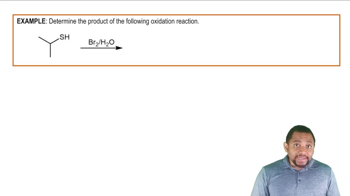
Reactions of Thiols Example 1

Disulfide Bond Formation

A disulfide bond is formed when two thiol groups undergo oxidation, resulting in the linkage of two sulfur atoms (S-S). This reaction typically occurs in the presence of an oxidizing agent, which facilitates the removal of hydrogen atoms from the thiol groups. Disulfide bonds are crucial in stabilizing the three-dimensional structures of proteins.
Recommended video:
Guided course
2:19
Phosphodiester Bond Formation Concept 1

Oxidizing Agents

An oxidizing agent is a substance that facilitates oxidation by accepting electrons from another substance. In the context of thiols, common oxidizing agents include hydrogen peroxide and iodine, which can convert thiols into disulfides. Understanding the role of oxidizing agents is essential for predicting the outcome of chemical reactions involving thiols.
Recommended video:
Guided course
1:49
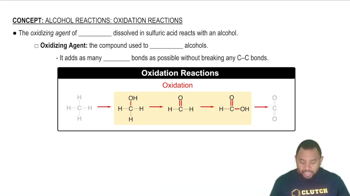
Alcohol Reactions: Oxidation Concept 1