Pearson+ LogoPearson+ Logo
Ch.14 Some Compounds with Oxygen, Sulfur, or a Halogen
McMurry - Fundamentals of GOB 8th Edition
McMurry8th EditionFundamentals of GOBISBN: 9780134015187Not the one you use?Change textbook
Chapter 14, Problem 9b

What alcohols yield the following alkenes as the major product on dehydration?
b.

Verified step by step guidance
1
Step 1: Understand the dehydration reaction. Dehydration of alcohols involves the removal of a water molecule (H₂O) to form an alkene. This reaction typically occurs in the presence of an acid catalyst, such as H₂SO₄ or H₃PO₄, and heat.
Step 2: Analyze the given alkene structure. Identify the carbon atoms involved in the double bond and their substituents. This will help determine the possible alcohol precursor(s).
Step 3: Recall the mechanism of alcohol dehydration. The reaction proceeds via the E1 or E2 mechanism, depending on the type of alcohol (primary, secondary, or tertiary). For secondary and tertiary alcohols, the E1 mechanism is more common and involves the formation of a carbocation intermediate.
Step 4: Work backward from the alkene. To determine the alcohol precursor, add an -OH group to one of the carbon atoms in the double bond. Consider all possible positions for the -OH group that would lead to the given alkene as the major product. Keep in mind Zaitsev's rule, which states that the more substituted alkene is usually the major product.
Step 5: Verify the structure of the alcohol(s). Ensure that the proposed alcohol(s) can undergo dehydration to yield the given alkene. Consider the stability of the carbocation intermediate (if applicable) and the regioselectivity of the reaction.

Verified video answer for a similar problem:

This video solution was recommended by our tutors as helpful for the problem above.
Was this helpful?

Key Concepts

Here are the essential concepts you must grasp in order to answer the question correctly.

Dehydration of Alcohols

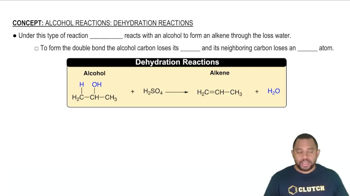
Dehydration of alcohols is a chemical reaction where an alcohol loses a water molecule, resulting in the formation of an alkene. This process typically occurs under acidic conditions and involves the protonation of the alcohol, followed by the elimination of water. Understanding this mechanism is crucial for predicting the products formed during the reaction.
Recommended video:
Guided course
1:30
Alcohol Reactions: Dehydration Reactions Concept 1

Zaitsev's Rule

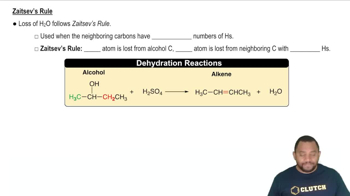
Zaitsev's Rule states that in elimination reactions, the more substituted alkene is usually the major product. This principle helps predict the outcome of dehydration reactions by favoring the formation of alkenes that are more stable due to greater substitution. Recognizing this rule is essential for determining which alkene will be predominant in a given dehydration scenario.
Recommended video:
Guided course
1:24
Zaitsev’s Rule Concept 2

Regioselectivity

Regioselectivity refers to the preference of a chemical reaction to yield one structural isomer over others when multiple products are possible. In the context of alcohol dehydration, regioselectivity helps identify which alkene is formed based on the structure of the starting alcohol. This concept is vital for understanding how different alcohols can lead to different alkene products during dehydration.