Pearson+ LogoPearson+ Logo
Ch.14 Some Compounds with Oxygen, Sulfur, or a Halogen
McMurry - Fundamentals of GOB 8th Edition
McMurry8th EditionFundamentals of GOBISBN: 9780134015187Not the one you use?Change textbook
Chapter 14, Problem 7c

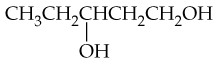
For each of the following molecules, (i) redraw using line structure format, (ii) identify its hydrophobic and hydrophilic parts, and (iii) predict its solubility in water.
c. Line structure of a molecule with hydrophilic hydroxyl group and hydrophobic carbon chain, illustrating solubility concepts.

Verified step by step guidance
1
Step 1: Redraw the molecule using the line structure format. In a line structure, carbon atoms are represented as vertices or endpoints of lines, and hydrogen atoms bonded to carbon are implied. Explicitly show any functional groups (e.g., -OH, -COOH) and heteroatoms (e.g., O, N).
Step 2: Identify the hydrophobic parts of the molecule. These are typically nonpolar regions, such as long hydrocarbon chains or aromatic rings, which do not interact well with water.
Step 3: Identify the hydrophilic parts of the molecule. These are polar or charged regions, such as -OH, -COOH, -NH2, or other functional groups capable of forming hydrogen bonds with water.
Step 4: Analyze the balance between hydrophobic and hydrophilic regions to predict the molecule's solubility in water. Molecules with significant hydrophilic regions are more likely to be water-soluble, while those dominated by hydrophobic regions are less soluble.
Step 5: Summarize your findings by stating whether the molecule is likely to be soluble, partially soluble, or insoluble in water based on the identified regions and their relative proportions.

Verified video answer for a similar problem:

This video solution was recommended by our tutors as helpful for the problem above.
Was this helpful?

Key Concepts

Here are the essential concepts you must grasp in order to answer the question correctly.

Line Structure Format

Line structure format is a simplified way of representing organic molecules where lines represent bonds between atoms, and vertices represent carbon atoms. This format omits hydrogen atoms attached to carbons for clarity, making it easier to visualize complex structures. Understanding this format is essential for accurately redrawing molecules and analyzing their functional groups.
Recommended video:
Guided course
1:41
Amide Formation Concept 1

Hydrophobic and Hydrophilic Parts

Hydrophobic parts of a molecule are non-polar regions that repel water, while hydrophilic parts are polar or ionic regions that attract water. This distinction is crucial for predicting how a molecule interacts with water and its overall solubility. Identifying these regions helps in understanding the molecule's behavior in biological systems and its potential applications.
Recommended video:
Guided course
01:38
Parts per Million (ppm) Concept 1

Solubility in Water

Solubility in water refers to the ability of a substance to dissolve in water, which is influenced by the molecule's polarity and the presence of hydrophilic or hydrophobic groups. Polar molecules tend to be soluble in water, while non-polar molecules are generally insoluble. Predicting solubility is important for applications in chemistry, biology, and pharmacology, as it affects how substances interact in aqueous environments.
Recommended video:
Guided course
02:07
Solubility Rules