Pearson+ LogoPearson+ Logo
Ch.14 Some Compounds with Oxygen, Sulfur, or a Halogen
McMurry - Fundamentals of GOB 8th Edition
McMurry8th EditionFundamentals of GOBISBN: 9780134015187Not the one you use?Change textbook
Chapter 14, Problem 14

Draw structures for the following:
a. 2,4-Dinitrophenol
b. m-Ethylphenol

Verified step by step guidance
1
Step 1: Understand the structure of the benzene ring, which is the base structure for both compounds. A benzene ring is a six-membered aromatic ring with alternating double bonds.
Step 2: For 2,4-Dinitrophenol, identify the substituents: a hydroxyl group (-OH) and two nitro groups (-NO₂). The hydroxyl group is attached to position 1 of the benzene ring, and the nitro groups are attached to positions 2 and 4 relative to the hydroxyl group.
Step 3: Draw the benzene ring and place the hydroxyl group (-OH) on one carbon atom (position 1). Then, place the nitro groups (-NO₂) on the second and fourth carbons relative to the hydroxyl group. Ensure the positions are correct based on the numbering system.
Step 4: For m-Ethylphenol, identify the substituents: a hydroxyl group (-OH) and an ethyl group (-CH₂CH₃). The hydroxyl group is attached to position 1 of the benzene ring, and the ethyl group is attached to the meta position (position 3) relative to the hydroxyl group.
Step 5: Draw the benzene ring and place the hydroxyl group (-OH) on one carbon atom (position 1). Then, place the ethyl group (-CH₂CH₃) on the third carbon relative to the hydroxyl group. Verify the structure to ensure the substituents are correctly positioned.

Verified video answer for a similar problem:

This video solution was recommended by our tutors as helpful for the problem above.
Was this helpful?

Key Concepts

Here are the essential concepts you must grasp in order to answer the question correctly.

Functional Groups

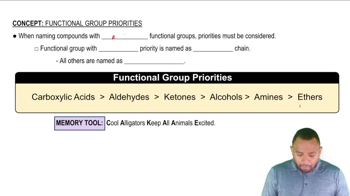
Functional groups are specific groups of atoms within molecules that are responsible for the characteristic chemical reactions of those molecules. In organic chemistry, recognizing functional groups like hydroxyl (-OH) in phenols or nitro (-NO2) in dinitrophenol is essential for understanding the properties and reactivity of compounds.
Recommended video:
Guided course
1:11
Functional Group Priorities Concept 1

Aromatic Compounds

Aromatic compounds are a class of cyclic compounds that follow Huckel's rule, which states that they must have a planar structure with a specific number of π electrons (4n + 2). These compounds, such as phenols, exhibit unique stability and reactivity due to their delocalized electrons, making them important in various chemical reactions.
Recommended video:
Guided course
02:11
Naming Ionic Compounds

Nomenclature in Organic Chemistry

Nomenclature in organic chemistry refers to the systematic naming of chemical compounds based on their structure and functional groups. Understanding the IUPAC naming conventions is crucial for accurately identifying and drawing the structures of compounds like 2,4-Dinitrophenol and m-Ethylphenol, which helps in communication and comprehension within the field.
Recommended video:
Guided course
2:26
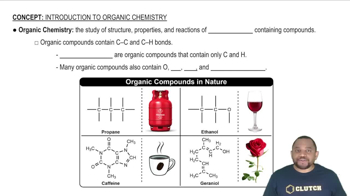
Introduction to Organic Chemistry Concept 1