Pearson+ LogoPearson+ Logo
Ch.16 Amines
McMurry - Fundamentals of GOB 8th Edition
McMurry8th EditionFundamentals of GOBISBN: 9780134015187Not the one you use?Change textbook
Chapter 16, Problem 26

Explain what bonds must be made or broken and where the electrons go when the hydrogen-bonded water between the two amines shown on page 507 reacts to form an amine, ammonium ion, and OH⁻.

Verified step by step guidance
1
Identify the reactants and products in the reaction: The reactants are two amines with hydrogen-bonded water, and the products are an amine, an ammonium ion, and a hydroxide ion (OH⁻). This indicates that a proton transfer is occurring.
Understand the role of water: Water acts as a proton donor (acid) in this reaction. One of the amines will accept a proton from water, forming an ammonium ion (R-NH₃⁺), while the remaining hydroxide ion (OH⁻) is left behind.
Determine the bonds broken: The O-H bond in water must be broken to release the proton (H⁺). This bond breaking involves the movement of electrons from the O-H bond to the oxygen atom, resulting in the formation of OH⁻.
Determine the bonds formed: The lone pair of electrons on the nitrogen atom of one amine will form a new bond with the proton (H⁺) from water, creating the ammonium ion (R-NH₃⁺).
Track the electron movement: The electrons from the O-H bond in water move to the oxygen atom, forming OH⁻. Simultaneously, the lone pair of electrons on the nitrogen atom of the amine is used to form the N-H bond in the ammonium ion. This electron movement ensures charge balance and the formation of the products.

Verified video answer for a similar problem:

This video solution was recommended by our tutors as helpful for the problem above.
Was this helpful?

Key Concepts

Here are the essential concepts you must grasp in order to answer the question correctly.

Hydrogen Bonding

Hydrogen bonding is a type of weak chemical bond that occurs when a hydrogen atom covalently bonded to a highly electronegative atom, like oxygen or nitrogen, experiences an attraction to another electronegative atom. In the context of water, these bonds are crucial for its unique properties and play a significant role in the interactions between water and amines, influencing the reaction dynamics.
Recommended video:
Guided course
1:22
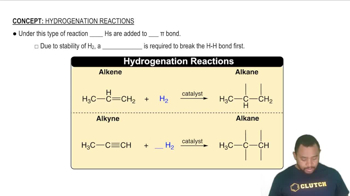
Hydrogenation Reactions Concept 1

Amine and Ammonium Ion Formation

Amines are organic compounds derived from ammonia by replacing one or more hydrogen atoms with alkyl or aryl groups. When an amine reacts with water, it can accept a proton (H⁺) to form an ammonium ion (NH₄⁺). This process involves the breaking of hydrogen bonds in water and the transfer of electrons, which is essential for understanding the reaction mechanism.
Recommended video:
Guided course
1:04
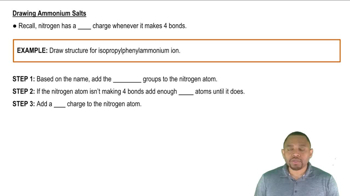
Drawing Ammonium Salts Concept 2

Electron Transfer in Reactions

Electron transfer is a fundamental concept in chemical reactions, where electrons are moved from one atom or molecule to another. In the reaction described, the transfer of electrons is critical for the formation of the ammonium ion and hydroxide ion (OH⁻). Understanding how electrons are redistributed during the reaction helps clarify the changes in bonding and the resulting products.
Recommended video:
Guided course
01:23
Electronic Structure: Electron Spin Concept 1