Pearson+ LogoPearson+ Logo
Ch.16 Amines
McMurry - Fundamentals of GOB 8th Edition
McMurry8th EditionFundamentals of GOBISBN: 9780134015187Not the one you use?Change textbook
Chapter 16, Problem 24a

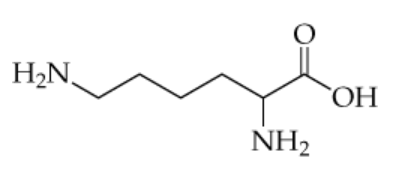
The structure of the amino acid lysine (in its uncharged form) is shown below.
Structure of the amino acid lysine in its uncharged form, highlighting potential hydrogen bonding amine groups.
a. Which amine groups would be able to participate in hydrogen bonding?

Verified step by step guidance
1
Examine the structure of lysine and identify all the amine groups present. Lysine contains two amine groups: one in the backbone (part of the amino group attached to the alpha carbon) and one in the side chain (part of the ε-amino group).
Recall that hydrogen bonding occurs when a hydrogen atom covalently bonded to an electronegative atom (like nitrogen) interacts with another electronegative atom. In this case, the nitrogen atoms in the amine groups can participate in hydrogen bonding.
Determine the hydrogen bonding capability of the backbone amine group. The nitrogen in the backbone amine group has a lone pair of electrons and is bonded to hydrogens, making it capable of acting as both a hydrogen bond donor (via its hydrogens) and a hydrogen bond acceptor (via its lone pair).
Analyze the side chain ε-amino group. Similar to the backbone amine group, the nitrogen in the ε-amino group also has a lone pair of electrons and is bonded to hydrogens, allowing it to act as both a hydrogen bond donor and acceptor.
Conclude that both the backbone amine group and the side chain ε-amino group in lysine can participate in hydrogen bonding, either by donating hydrogen atoms or by using their lone pairs to accept hydrogen bonds.

Verified video answer for a similar problem:

This video solution was recommended by our tutors as helpful for the problem above.
Was this helpful?

Key Concepts

Here are the essential concepts you must grasp in order to answer the question correctly.

Amino Acid Structure

Amino acids are organic compounds that serve as the building blocks of proteins. Each amino acid consists of a central carbon atom, an amino group (–NH2), a carboxyl group (–COOH), a hydrogen atom, and a variable side chain (R group). The structure of lysine includes two amine groups, which are crucial for its properties and interactions.
Recommended video:
Guided course
3:03
Amino Acid Catabolism: Amino Group Example 2

Hydrogen Bonding

Hydrogen bonding is a type of weak chemical bond that occurs when a hydrogen atom covalently bonded to an electronegative atom, such as nitrogen or oxygen, experiences an attraction to another electronegative atom. In the context of amino acids, the presence of amine groups allows for potential hydrogen bonding with other molecules, influencing protein structure and function.
Recommended video:
Guided course
1:22
Hydrogenation Reactions Concept 1

Uncharged Form of Amino Acids

The uncharged form of an amino acid refers to its state at a specific pH where the amino and carboxyl groups are not ionized. For lysine, this means that the amino groups are available for hydrogen bonding without the influence of charge, which can affect solubility and interactions with other molecules in biological systems.
Recommended video:
Guided course
1:37
Amino Acid Catabolism: Amino Group Example 1