Pearson+ LogoPearson+ Logo
Ch.16 Amines
McMurry - Fundamentals of GOB 8th Edition
McMurry8th EditionFundamentals of GOBISBN: 9780134015187Not the one you use?Change textbook
Chapter 16, Problem 21

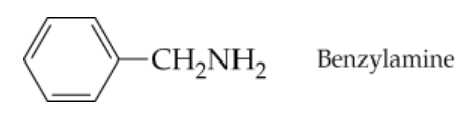
Write the structure of benzylamine hydrochloride in two different ways, and name the hydrochloride as an ammonium salt.
Structure of benzylamine with its chemical formula and name displayed alongside.

Verified step by step guidance
1
Step 1: Understand the structure of benzylamine. Benzylamine consists of a benzene ring (C₆H₅-) attached to a -CH₂ group, which is further bonded to an amine group (-NH₂).
Step 2: Recognize that benzylamine hydrochloride is the salt formed when benzylamine reacts with hydrochloric acid (HCl). The amine group (-NH₂) accepts a proton (H⁺) from HCl, forming the ammonium ion (-NH₃⁺).
Step 3: Write the structure of benzylamine hydrochloride in its ionic form. This includes the benzylammonium ion (C₆H₅-CH₂-NH₃⁺) and the chloride ion (Cl⁻).
Step 4: Write the structure of benzylamine hydrochloride in its condensed form. This can be represented as C₆H₅-CH₂-NH₃⁺Cl⁻, showing the ammonium salt as a single entity.
Step 5: Name the compound as benzylammonium chloride. The name reflects the ammonium salt formed by the protonation of benzylamine and the presence of the chloride counterion.

Verified video answer for a similar problem:

This video solution was recommended by our tutors as helpful for the problem above.
Was this helpful?

Key Concepts

Here are the essential concepts you must grasp in order to answer the question correctly.

Benzylamine Structure

Benzylamine is an organic compound consisting of a benzene ring attached to an amine group (-NH2). Its structure can be represented in two ways: the condensed structural formula (C6H5CH2NH2) and a skeletal structure showing the connectivity of atoms. Understanding its structure is essential for recognizing its chemical properties and reactivity.
Recommended video:
Guided course
1:01
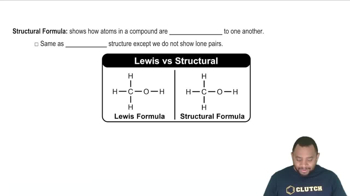
Structural Formula Concept 2

Hydrochloride Formation

Hydrochloride salts are formed when an amine reacts with hydrochloric acid, resulting in the protonation of the amine group. This process converts the amine into an ammonium ion, which pairs with the chloride ion (Cl-) from the acid. This transformation is crucial for enhancing the solubility and stability of the amine in various applications.
Recommended video:
Guided course
1:41
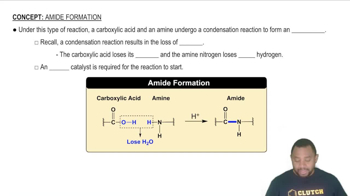
Amide Formation Concept 1

Ammonium Salts

Ammonium salts are ionic compounds formed from the reaction of an amine with an acid, where the amine becomes a positively charged ammonium ion. These salts are typically more soluble in water than their parent amines and are commonly used in pharmaceuticals and chemical synthesis. Recognizing benzylamine hydrochloride as an ammonium salt highlights its properties and potential uses.
Recommended video:
Guided course
1:04
Drawing Ammonium Salts Concept 2