
Pearson+ LogoPearson+ Logo
Ch.17 Carboxylic Acids and Their Derivatives
McMurry - Fundamentals of GOB 8th Edition
McMurry8th EditionFundamentals of GOBISBN: 9780134015187Not the one you use?Change textbook
Chapter 17, Problem 83

Draw all possible carboxylic acids with the formula C5H10O2.

Verified step by step guidance
1
Step 1: Understand the molecular formula C₅H₁₀O₂. This formula indicates a carboxylic acid with 5 carbon atoms, 10 hydrogen atoms, and 2 oxygen atoms. The presence of a carboxylic acid group (-COOH) is essential, which accounts for one carbon, one oxygen (double-bonded), and one hydroxyl group (-OH).
Step 2: Determine the remaining structure. After accounting for the carboxylic acid group, there are 4 carbons and 9 hydrogens left to arrange. These will form the hydrocarbon chain or branches attached to the carboxylic acid group.
Step 3: Draw the straight-chain structure. Start by attaching the carboxylic acid group (-COOH) to a straight chain of 4 carbons. This is the simplest structure, known as pentanoic acid.
Step 4: Consider branching. Rearrange the remaining 4 carbons into branched structures while keeping the carboxylic acid group intact. For example, you can create isomers by placing a methyl group (-CH₃) on the second or third carbon of the main chain.
Step 5: Verify all structures. Ensure that each structure adheres to the molecular formula C₅H₁₀O₂, contains a carboxylic acid group, and does not duplicate any previously drawn isomers. Label each isomer appropriately (e.g., 2-methylbutanoic acid, 3-methylbutanoic acid).

Verified video answer for a similar problem:

This video solution was recommended by our tutors as helpful for the problem above.
Was this helpful?

Key Concepts

Here are the essential concepts you must grasp in order to answer the question correctly.

Carboxylic Acids

Carboxylic acids are organic compounds characterized by the presence of one or more carboxyl groups (-COOH). They are known for their acidic properties due to the ability of the carboxyl group to donate a proton (H+). The general formula for carboxylic acids is R-COOH, where R represents a hydrocarbon chain. Understanding the structure and functional group of carboxylic acids is essential for identifying and drawing them.
Recommended video:
Guided course
1:09
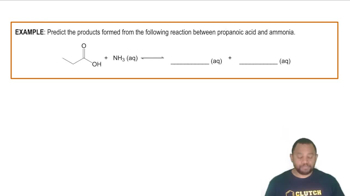
Carboxylic Acid Reactions Example 1

Molecular Formula and Structural Isomers

The molecular formula C₅H₁₀O₂ indicates that the compound contains five carbon atoms, ten hydrogen atoms, and two oxygen atoms. This formula can correspond to multiple structural isomers, which are compounds with the same molecular formula but different arrangements of atoms. Identifying all possible structural isomers is crucial for drawing all carboxylic acids that fit the given formula, as the arrangement affects the properties and classification of the acids.
Recommended video:
Guided course
02:08
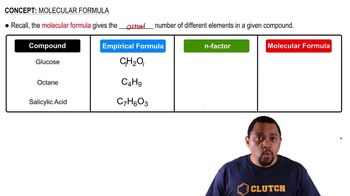
Molecular Formula

Functional Groups and Classification

Functional groups are specific groups of atoms within molecules that determine the chemical properties and reactions of those molecules. In the case of carboxylic acids, the carboxyl group is the functional group that defines their behavior. Carboxylic acids can be classified based on the length of their carbon chains and the presence of other functional groups, which is important for understanding the variety of compounds that can be derived from the same molecular formula.
Recommended video:
Guided course
1:11
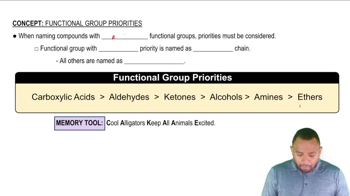
Functional Group Priorities Concept 1