Pearson+ LogoPearson+ Logo
Ch.17 Carboxylic Acids and Their Derivatives
McMurry - Fundamentals of GOB 8th Edition
McMurry8th EditionFundamentals of GOBISBN: 9780134015187Not the one you use?Change textbook
Chapter 17, Problem 1c

Identify the following molecules as a carboxylic acid, an amide, an ester, or none of these.
c. CH3COOH

Verified step by step guidance
1
Step 1: Begin by analyzing the molecular formula provided, CH₃COOH. Break it down into its functional groups to identify the key components.
Step 2: Recognize that the molecule contains a -COOH group, which is characteristic of carboxylic acids. This functional group consists of a carbon atom double-bonded to an oxygen atom and single-bonded to a hydroxyl group (-OH).
Step 3: Compare the structure of CH₃COOH to the definitions of other functional groups such as amides (-CONH₂), esters (-COOR), and others. Confirm that it does not match the structural criteria for these groups.
Step 4: Recall that carboxylic acids are organic compounds that typically have acidic properties due to the presence of the -COOH group, which can donate a proton (H⁺).
Step 5: Conclude that CH₃COOH is a carboxylic acid based on the presence of the -COOH functional group and its structural characteristics.

Verified video answer for a similar problem:

This video solution was recommended by our tutors as helpful for the problem above.
Was this helpful?

Key Concepts

Here are the essential concepts you must grasp in order to answer the question correctly.

Carboxylic Acid

Carboxylic acids are organic compounds characterized by the presence of a carboxyl group (-COOH). This functional group consists of a carbon atom double-bonded to an oxygen atom and single-bonded to a hydroxyl group (-OH). They are known for their acidic properties and are commonly found in various biological and industrial processes. An example is acetic acid (CH₃COOH), which is the main component of vinegar.
Recommended video:
Guided course
1:09
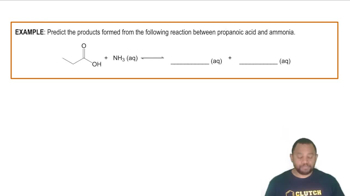
Carboxylic Acid Reactions Example 1

Functional Groups

Functional groups are specific groups of atoms within molecules that are responsible for the characteristic chemical reactions of those molecules. They determine the properties and reactivity of organic compounds. Common functional groups include hydroxyl (-OH), carbonyl (C=O), and carboxyl (-COOH). Identifying these groups is essential for classifying organic compounds into categories such as acids, bases, and esters.
Recommended video:
Guided course
1:11
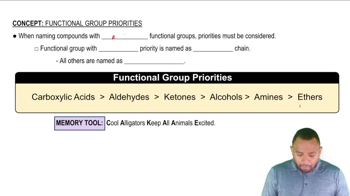
Functional Group Priorities Concept 1

Molecular Classification

Molecular classification involves categorizing organic compounds based on their functional groups and structural features. This classification helps in understanding the chemical behavior and potential reactions of the molecules. For instance, compounds can be classified as carboxylic acids, amides, or esters based on the presence of specific functional groups. This systematic approach is crucial in organic chemistry for predicting reactivity and interactions.
Recommended video:
Guided course
02:08
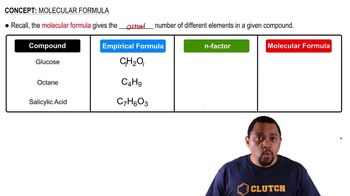
Molecular Formula