Pearson+ LogoPearson+ Logo
Ch.17 Carboxylic Acids and Their Derivatives
McMurry - Fundamentals of GOB 8th Edition
McMurry8th EditionFundamentals of GOBISBN: 9780134015187Not the one you use?Change textbook
Chapter 17, Problem 80

Write the formula of the triester formed from glycerol and stearic acid.

Verified step by step guidance
1
Identify the structure of glycerol: Glycerol is a triol, meaning it has three hydroxyl (-OH) groups attached to a three-carbon backbone. Its chemical formula is C₃H₈O₃.
Identify the structure of stearic acid: Stearic acid is a saturated fatty acid with the chemical formula C₁₇H₃₅COOH. It contains a carboxylic acid (-COOH) group and a long hydrocarbon chain.
Understand the reaction: A triester is formed when glycerol reacts with three molecules of a fatty acid (in this case, stearic acid) through an esterification reaction. Each hydroxyl group of glycerol reacts with the carboxylic acid group of stearic acid, releasing water (H₂O) and forming an ester bond.
Write the general formula for the triester: The resulting triester will have the glycerol backbone with three stearic acid chains attached via ester bonds. The formula can be written as C₃H₅(OCOC₁₇H₃₅)₃, where each hydroxyl group of glycerol is replaced by an ester group (-OCOC₁₇H₃₅).
Verify the structure: Ensure that the triester has three ester linkages, one for each hydroxyl group of glycerol, and that the stearic acid chains are correctly attached. This confirms the formation of the triester from glycerol and stearic acid.

Verified video answer for a similar problem:

This video solution was recommended by our tutors as helpful for the problem above.
Was this helpful?

Key Concepts

Here are the essential concepts you must grasp in order to answer the question correctly.

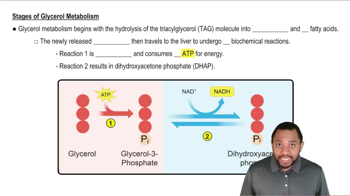
Glycerol

Glycerol, also known as glycerin, is a simple polyol compound that serves as a backbone for triglycerides and phospholipids. It consists of three carbon atoms, each bonded to a hydroxyl group (-OH). In the context of esterification, glycerol reacts with fatty acids to form esters, specifically triglycerides, which are important in biological systems as energy storage molecules.
Recommended video:
Guided course
1:20
Glycerol Metabolism Concept 2

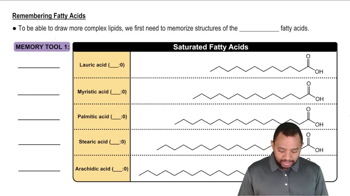
Stearic Acid

Stearic acid is a saturated fatty acid with an 18-carbon chain, commonly found in animal and plant fats. Its chemical formula is C18H36O2, and it plays a crucial role in the formation of triglycerides. When stearic acid reacts with glycerol, it forms a triester, which is a type of lipid that is a major component of dietary fats and oils.
Recommended video:
Guided course
1:50
Fatty Acids Concept 5

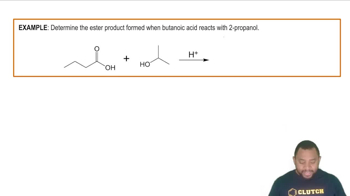
Esterification

Esterification is a chemical reaction between an alcohol and a carboxylic acid, resulting in the formation of an ester and water. In the case of glycerol and stearic acid, the reaction involves the hydroxyl groups of glycerol and the carboxyl group of stearic acid, leading to the formation of a triester known as a triglyceride. This process is fundamental in biochemistry, particularly in the synthesis of fats.
Recommended video:
Guided course
0:46
Ester Reactions: Esterification Example 1