Pearson+ LogoPearson+ Logo
Ch.17 Carboxylic Acids and Their Derivatives
McMurry - Fundamentals of GOB 8th Edition
McMurry8th EditionFundamentals of GOBISBN: 9780134015187Not the one you use?Change textbook
Chapter 17, Problem 56

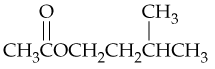
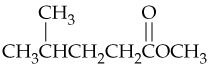
Draw structures of the carboxylic acids and alcohols you would use to prepare each ester in Problem 17.54.
a.
b.
c. Cyclohexyl acetate
d. Phenyl-o-hydroxybenzoate

Verified step by step guidance
1
Identify the ester in Problem 17.54. An ester is a compound with the general structure RCOOR', where R and R' are alkyl or aryl groups. The ester is formed by the reaction of a carboxylic acid and an alcohol through a process called esterification.
Break the ester structure into two parts: the portion containing the carbonyl group (C=O) and the portion attached to the oxygen atom (O-R'). The carbonyl-containing part corresponds to the carboxylic acid, and the O-R' part corresponds to the alcohol.
Draw the structure of the carboxylic acid by replacing the -OR' group in the ester with an -OH group. This gives the carboxylic acid structure RCOOH.
Draw the structure of the alcohol by isolating the R' group and attaching it to an -OH group. This gives the alcohol structure R'OH.
Verify the structures by mentally combining the carboxylic acid and alcohol through esterification (removal of water, H₂O) to ensure they form the original ester. This confirms the correctness of the drawn structures.

Verified video answer for a similar problem:

This video solution was recommended by our tutors as helpful for the problem above.
Was this helpful?

Key Concepts

Here are the essential concepts you must grasp in order to answer the question correctly.

Carboxylic Acids

Carboxylic acids are organic compounds characterized by the presence of a carboxyl group (-COOH). They are known for their acidic properties and can participate in various chemical reactions, including esterification. In the context of preparing esters, the carboxylic acid provides the acyl group that combines with an alcohol to form the ester.
Recommended video:
Guided course
1:09
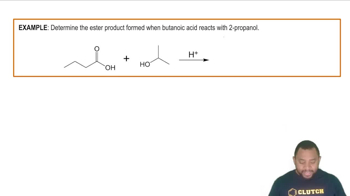
Carboxylic Acid Reactions Example 1

Alcohols

Alcohols are organic compounds that contain one or more hydroxyl groups (-OH) attached to a carbon atom. They are versatile reactants in organic chemistry and play a crucial role in the formation of esters through a reaction with carboxylic acids. The alcohol contributes the alkyl group to the ester, which is essential for determining the ester’s properties.
Recommended video:
Guided course
1:10
Alcohol Classification Concept 2

Esterification Reaction

Esterification is a chemical reaction between a carboxylic acid and an alcohol, resulting in the formation of an ester and water. This reaction typically requires an acid catalyst and involves the nucleophilic attack of the alcohol's hydroxyl group on the carbonyl carbon of the carboxylic acid. Understanding this reaction is vital for predicting the structures of the reactants needed to synthesize specific esters.
Recommended video:
Guided course
0:46
Ester Reactions: Esterification Example 1