Pearson+ LogoPearson+ Logo
Ch.17 Carboxylic Acids and Their Derivatives
McMurry - Fundamentals of GOB 8th Edition
McMurry8th EditionFundamentals of GOBISBN: 9780134015187Not the one you use?Change textbook
Chapter 17, Problem 67b

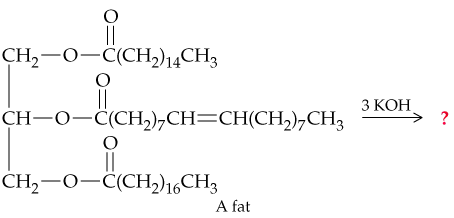
Household soap is a mixture of the sodium or potassium salts of long-chain carboxylic acids that arise from saponification of animal fat.
b. Draw the structures of the soap molecules produced in the following reaction:

Verified step by step guidance
1
Identify the reactants in the saponification reaction. Saponification involves the reaction of a triglyceride (animal fat) with a strong base, such as sodium hydroxide (NaOH) or potassium hydroxide (KOH). The triglyceride consists of a glycerol backbone attached to three long-chain fatty acid esters.
Understand the reaction mechanism. In saponification, the ester bonds in the triglyceride are hydrolyzed by the strong base, resulting in the formation of glycerol (a byproduct) and the sodium or potassium salts of the fatty acids (soap molecules).
Determine the structure of the soap molecules. The soap molecules are the deprotonated forms of the fatty acids, where the carboxylic acid group (-COOH) is converted into a carboxylate ion (-COO⁻) and paired with a sodium (Na⁺) or potassium (K⁺) ion.
Draw the structure of the soap molecules. For each fatty acid chain, replace the ester bond with a carboxylate group (-COO⁻) at the end of the chain. Attach the sodium (Na⁺) or potassium (K⁺) ion to the carboxylate group to complete the soap molecule structure.
Verify the products. Ensure that the reaction produces three soap molecules (one for each fatty acid chain in the triglyceride) and one glycerol molecule. Confirm that the structures are consistent with the reactants and the saponification process.

Verified video answer for a similar problem:

This video solution was recommended by our tutors as helpful for the problem above.
Was this helpful?

Key Concepts

Here are the essential concepts you must grasp in order to answer the question correctly.

Saponification

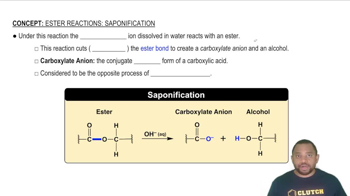
Saponification is a chemical reaction that occurs when fats or oils react with an alkali, typically sodium hydroxide or potassium hydroxide, to produce soap and glycerol. This process involves the hydrolysis of triglycerides, breaking them down into fatty acid salts and glycerin. Understanding saponification is crucial for grasping how soap molecules are formed from animal fats.
Recommended video:
Guided course
1:25
Ester Reactions: Saponification Concept 1

Soap Structure

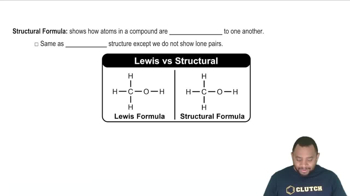
Soap molecules consist of long hydrocarbon chains with a polar carboxylate group at one end. The hydrocarbon tail is hydrophobic (water-repelling), while the carboxylate head is hydrophilic (water-attracting). This dual nature allows soap to emulsify oils and fats in water, making it effective for cleaning. Drawing the structure involves illustrating both the hydrophobic tail and the hydrophilic head.
Recommended video:
Guided course
1:01
Structural Formula Concept 2

Fatty Acids

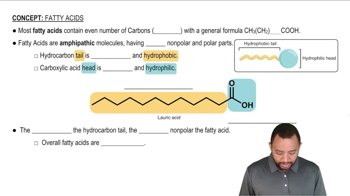
Fatty acids are carboxylic acids with long hydrocarbon chains, which can be saturated or unsaturated. They are the building blocks of lipids and are released during the saponification process. The specific fatty acids present in the soap depend on the type of fat used, influencing the soap's properties such as lathering ability and moisturizing effects.
Recommended video:
Guided course
2:00
Fatty Acids Concept 1