
Pearson+ LogoPearson+ Logo
Ch.17 Carboxylic Acids and Their Derivatives
McMurry - Fundamentals of GOB 8th Edition
McMurry8th EditionFundamentals of GOBISBN: 9780134015187Not the one you use?Change textbook
Chapter 17, Problem 71a

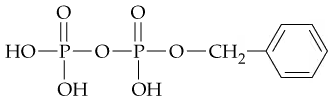
In the following compound
Chemical structure of a phosphate ester linkage with two phosphate groups connected to a benzyl group.
a. Identify the phosphate ester linkage.

Verified step by step guidance
1
Examine the structure of the compound provided in the image. Look for a phosphate group, which is typically represented as a phosphorus atom (P) bonded to four oxygen atoms (O).
Identify the ester linkage within the phosphate group. An ester linkage is formed when a phosphate group is bonded to an organic group (such as a carbon chain) through an oxygen atom.
Locate the specific bond where the oxygen atom of the phosphate group is connected to a carbon atom of the organic molecule. This bond represents the phosphate ester linkage.
Verify that the identified linkage meets the criteria of a phosphate ester: a phosphorus atom bonded to an oxygen atom, which is further bonded to a carbon atom.
Highlight or label the phosphate ester linkage in the compound for clarity and confirmation of your identification.

Verified video answer for a similar problem:

This video solution was recommended by our tutors as helpful for the problem above.
Was this helpful?

Key Concepts

Here are the essential concepts you must grasp in order to answer the question correctly.

Phosphate Ester Linkage

A phosphate ester linkage is a chemical bond formed between a phosphate group and an alcohol, resulting in the formation of an ester. In biological molecules, this linkage is crucial for the structure of nucleotides, which are the building blocks of nucleic acids like DNA and RNA. The phosphate group connects to the hydroxyl group of the sugar molecule, facilitating the formation of the backbone of nucleic acids.
Recommended video:
Guided course
1:44
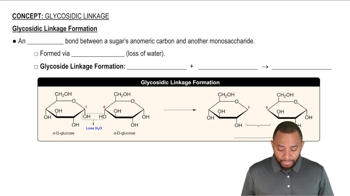
Glycosidic Linkage Formation Concept 1

Nucleotide Structure

Nucleotides are the basic units of nucleic acids, consisting of three components: a nitrogenous base, a five-carbon sugar, and a phosphate group. The arrangement of these components determines the identity of the nucleotide and its role in genetic information storage and transfer. Understanding nucleotide structure is essential for identifying the phosphate ester linkages in nucleic acids.
Recommended video:
Guided course
1:19
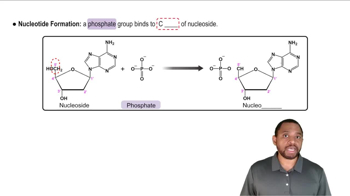
Nucleoside and Nucleotide Formation Concept 2

Chemical Bonding in Biochemistry

Chemical bonding in biochemistry refers to the interactions that hold molecules together, including covalent bonds, ionic bonds, and hydrogen bonds. In the context of nucleic acids, covalent bonds, such as the phosphate ester linkages, are particularly important as they provide stability and integrity to the molecular structure. Recognizing these bonds is key to understanding how biological molecules function and interact.
Recommended video:
Guided course
00:49
Chemical Reaction: Chemical Change Example 1