
Pearson+ LogoPearson+ Logo
Ch.17 Carboxylic Acids and Their Derivatives
McMurry - Fundamentals of GOB 8th Edition
McMurry8th EditionFundamentals of GOBISBN: 9780134015187Not the one you use?Change textbook
Chapter 17, Problem 69

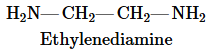
A simple polyamide can be made from ethylenediamine and oxalic acid (Table 17.1). Draw the polymer formed when three units of ethylenediamine reacts with two units of oxalic acid.

Verified step by step guidance
1
Identify the functional groups in ethylenediamine and oxalic acid. Ethylenediamine contains two amine groups (-NH2), while oxalic acid contains two carboxylic acid groups (-COOH). These groups will react to form amide bonds (-CONH-).
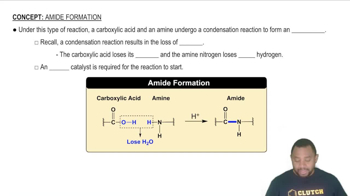
Understand the polymerization process. Each carboxylic acid group from oxalic acid reacts with an amine group from ethylenediamine, releasing a molecule of water (condensation reaction) and forming an amide bond.
Determine the sequence of the polymer. Since three units of ethylenediamine and two units of oxalic acid are involved, the polymer will alternate between the two monomers, starting and ending with ethylenediamine due to the stoichiometry.
Draw the repeating unit of the polymer. The repeating unit will consist of one ethylenediamine molecule connected to one oxalic acid molecule through amide bonds. Ensure that the terminal groups are correctly represented (an amine group at one end and a carboxylic acid group at the other).
Combine the repeating units to form the polymer. Link three ethylenediamine units and two oxalic acid units in the correct sequence, ensuring that each amide bond is properly formed and the polymer chain is continuous.

Verified video answer for a similar problem:

This video solution was recommended by our tutors as helpful for the problem above.
Was this helpful?

Key Concepts

Here are the essential concepts you must grasp in order to answer the question correctly.

Polyamide Formation

Polyamides are a type of polymer formed through the reaction of diamines and dicarboxylic acids. In this case, ethylenediamine, a diamine, reacts with oxalic acid, a dicarboxylic acid, to create a repeating unit of the polymer. The reaction involves the formation of amide bonds, which link the monomers together, resulting in a long-chain structure characteristic of polyamides.
Recommended video:
Guided course
1:41
Amide Formation Concept 1

Condensation Reaction

The formation of polyamides from ethylenediamine and oxalic acid is a condensation reaction, where two molecules combine to form a larger molecule while releasing a small molecule, typically water. This process is crucial in polymer chemistry as it leads to the growth of the polymer chain. Understanding this reaction type is essential for predicting the structure and properties of the resulting polymer.
Recommended video:
Guided course
1:53
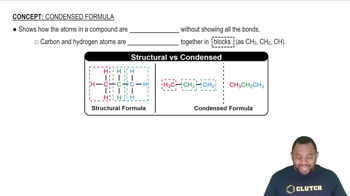
Condensed Formula Concept 1

Structural Representation of Polymers

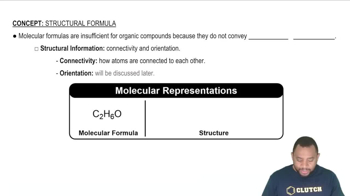
Drawing the polymer formed from the reaction requires an understanding of how to represent the repeating units and the overall structure of the polymer. This involves illustrating the backbone of the polymer, which consists of the amide linkages, and ensuring that the correct stoichiometry of the reactants is reflected in the final structure. Proper structural representation is key to visualizing the polymer's properties and potential applications.
Recommended video:
Guided course
2:08
Molecular Representations Concept 1