Pearson+ LogoPearson+ Logo
Ch.17 Carboxylic Acids and Their Derivatives
McMurry - Fundamentals of GOB 8th Edition
McMurry8th EditionFundamentals of GOBISBN: 9780134015187Not the one you use?Change textbook
Chapter 17, Problem 71b

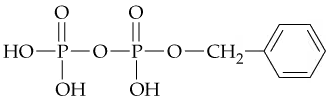
In the following compound

b. Identify the phosphate anhydride linkage.

Verified step by step guidance
1
Understand the term 'phosphate anhydride linkage': A phosphate anhydride linkage is a bond formed between two phosphate groups through the loss of a water molecule. This type of bond is commonly found in molecules like ATP (adenosine triphosphate).
Examine the structure of the compound provided in the image: Look for regions where two phosphate groups are directly connected by an oxygen atom, indicating the presence of a phosphate anhydride bond.
Identify the specific bond: Locate the bond between the phosphorus atoms of the two phosphate groups. This bond is typically represented as P-O-P, where the oxygen atom bridges the two phosphorus atoms.
Verify the linkage: Ensure that the bond you identified is indeed an anhydride bond by confirming that it connects two phosphate groups and is formed by the removal of a water molecule.
Label the phosphate anhydride linkage: Clearly mark or highlight the identified bond in the compound structure to indicate the phosphate anhydride linkage.

Verified video answer for a similar problem:

This video solution was recommended by our tutors as helpful for the problem above.
Was this helpful?

Key Concepts

Here are the essential concepts you must grasp in order to answer the question correctly.

Phosphate Anhydride Linkage

A phosphate anhydride linkage is a type of chemical bond formed between two phosphate groups through the removal of a water molecule. This bond is crucial in biochemistry, particularly in the formation of ATP (adenosine triphosphate), where energy is stored and released during cellular processes. Understanding this linkage is essential for grasping how energy transfer occurs in biological systems.
Recommended video:
Guided course
1:44
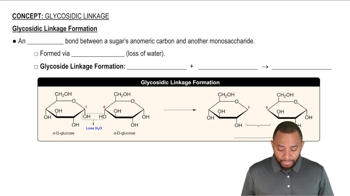
Glycosidic Linkage Formation Concept 1

Chemical Structure of Nucleotides

Nucleotides are the building blocks of nucleic acids like DNA and RNA, consisting of a phosphate group, a sugar, and a nitrogenous base. The arrangement of these components, particularly the phosphate groups, is vital for understanding how nucleotides link together to form long chains. Recognizing the structure helps in identifying functional groups and their roles in biochemical reactions.
Recommended video:
Guided course
1:19
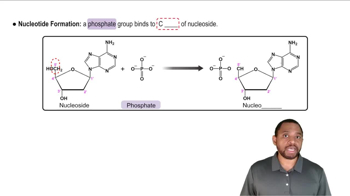
Nucleoside and Nucleotide Formation Concept 2

Role of Phosphate in Energy Transfer

Phosphate groups play a critical role in energy transfer within cells, primarily through molecules like ATP. The high-energy bonds between phosphate groups can be broken to release energy, which is then used for various cellular activities. This concept is fundamental in biochemistry, as it explains how cells harness and utilize energy for growth, repair, and maintenance.
Recommended video:
Guided course
01:26
Nature of Energy