Pearson+ LogoPearson+ Logo
Ch.17 Carboxylic Acids and Their Derivatives
McMurry - Fundamentals of GOB 8th Edition
McMurry8th EditionFundamentals of GOBISBN: 9780134015187Not the one you use?Change textbook
Chapter 17, Problem 65a

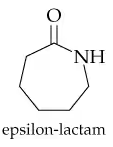
When both the carboxylic acid and the amine are in the same molecule, amide formation produces lactams. A lactam is a cyclic amide, where the amide group is part of the ring. Draw the structure of the product(s) obtained from acid hydrolysis of these lactams.
a. Structure of epsilon-lactam, a cyclic amide with an amide group in the ring.

Verified step by step guidance
1
Step 1: Understand the structure of epsilon-lactam. Epsilon-lactam is a six-membered cyclic amide, where the amide group is part of the ring. The structure includes a carbonyl group (C=O) bonded to a nitrogen atom within the ring.
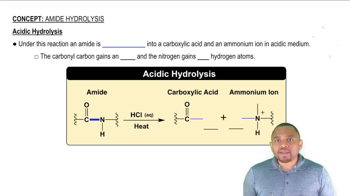
Step 2: Recall the concept of acid hydrolysis of amides. Acid hydrolysis involves breaking the amide bond (C-N bond) in the presence of water and an acid catalyst, resulting in the formation of a carboxylic acid and an amine or ammonium ion.
Step 3: Identify the bond to be broken in epsilon-lactam. The hydrolysis reaction will cleave the bond between the carbonyl carbon and the nitrogen atom in the amide group.
Step 4: Predict the products of the reaction. Breaking the amide bond in epsilon-lactam will yield a carboxylic acid (with the carbonyl group) and an amine group (from the nitrogen atom). Since the reaction occurs in acidic conditions, the amine will likely be protonated to form an ammonium ion.
Step 5: Draw the structures of the products. The carboxylic acid product will have a straight-chain structure with a terminal carboxyl group (-COOH), and the ammonium ion will be represented as NH4+ (if fully protonated). Ensure the structures reflect the correct number of carbon atoms from the original epsilon-lactam ring.

Verified video answer for a similar problem:

This video solution was recommended by our tutors as helpful for the problem above.
Was this helpful?

Key Concepts

Here are the essential concepts you must grasp in order to answer the question correctly.

Lactams

Lactams are cyclic amides formed when a carboxylic acid and an amine react within the same molecule, resulting in a ring structure that includes the amide group. They are classified based on the size of the ring, with epsilon-lactams being six-membered rings. Understanding lactams is crucial for predicting their chemical behavior, including their reactivity in hydrolysis.

Acid Hydrolysis

Acid hydrolysis is a chemical reaction where a compound reacts with water in the presence of an acid, leading to the breakdown of the compound. In the case of lactams, acid hydrolysis results in the cleavage of the amide bond, yielding the corresponding carboxylic acid and amine. This process is essential for understanding how lactams can be transformed back into their constituent parts.
Recommended video:
Guided course
1:12
Acidic Hydrolysis Concept 1

Amide Bond

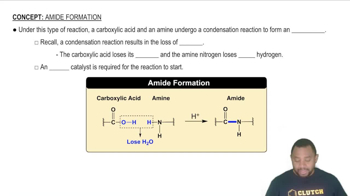
An amide bond is a functional group formed between a carboxylic acid and an amine, characterized by a carbonyl group (C=O) adjacent to a nitrogen atom (N). This bond is pivotal in the structure of lactams and influences their stability and reactivity. Recognizing the nature of the amide bond is key to predicting the outcomes of reactions involving lactams, including hydrolysis.
Recommended video:
Guided course
1:41
Amide Formation Concept 1