
Pearson+ LogoPearson+ Logo
Ch.17 Carboxylic Acids and Their Derivatives
McMurry - Fundamentals of GOB 8th Edition
McMurry8th EditionFundamentals of GOBISBN: 9780134015187Not the one you use?Change textbook
Chapter 17, Problem 78

Propanamide and methyl acetate have about the same molar mass, both are quite soluble in water, and yet the boiling point of propanamide is 213 °C, whereas that of methyl acetate is 57 °C. Explain.

Verified step by step guidance
1
Identify the functional groups in each compound: Propanamide contains an amide group (-CONH2), while methyl acetate contains an ester group (-COOCH3). These functional groups play a key role in determining the intermolecular forces present in each compound.
Analyze the intermolecular forces in propanamide: The amide group in propanamide can form strong hydrogen bonds due to the presence of both a hydrogen atom bonded to nitrogen (N-H) and a carbonyl group (C=O). These hydrogen bonds significantly increase the boiling point of propanamide.
Analyze the intermolecular forces in methyl acetate: The ester group in methyl acetate cannot form hydrogen bonds because it lacks a hydrogen atom bonded to a highly electronegative atom like oxygen or nitrogen. Instead, methyl acetate primarily exhibits dipole-dipole interactions and London dispersion forces, which are weaker than hydrogen bonding.
Relate the strength of intermolecular forces to boiling points: Stronger intermolecular forces, such as hydrogen bonding in propanamide, require more energy to overcome during the phase transition from liquid to gas. This results in a much higher boiling point for propanamide compared to methyl acetate, which only has weaker dipole-dipole and dispersion forces.
Conclude the explanation: The significant difference in boiling points (213 °C for propanamide vs. 57 °C for methyl acetate) is due to the presence of strong hydrogen bonding in propanamide, which is absent in methyl acetate. This highlights the impact of intermolecular forces on physical properties like boiling points.

Verified video answer for a similar problem:

This video solution was recommended by our tutors as helpful for the problem above.
Was this helpful?

Key Concepts

Here are the essential concepts you must grasp in order to answer the question correctly.

Intermolecular Forces

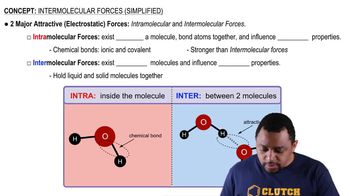
Intermolecular forces are the attractive forces between molecules that influence physical properties such as boiling points. Propanamide exhibits strong hydrogen bonding due to the presence of an amide group, which significantly raises its boiling point. In contrast, methyl acetate primarily experiences weaker dipole-dipole interactions and London dispersion forces, resulting in a lower boiling point.
Recommended video:
Guided course
01:59
Intermolecular Forces (Simplified) Concept 1

Hydrogen Bonding

Hydrogen bonding is a specific type of strong dipole-dipole interaction that occurs when hydrogen is bonded to highly electronegative atoms like nitrogen, oxygen, or fluorine. In propanamide, the nitrogen atom can form hydrogen bonds with water and other propanamide molecules, leading to a higher boiling point. Methyl acetate lacks such strong hydrogen bonding capabilities, contributing to its lower boiling point.
Recommended video:
Guided course
1:22
Hydrogenation Reactions Concept 1

Molar Mass vs. Boiling Point

While molar mass can influence boiling points, it is not the sole determinant. Both propanamide and methyl acetate have similar molar masses, but the type and strength of intermolecular forces play a more critical role. The significant difference in boiling points between these two compounds highlights that stronger intermolecular forces can lead to higher boiling points, regardless of similar molar masses.
Recommended video:
Guided course
03:05
Boiling Point Elevation Concept 1