Pearson+ LogoPearson+ Logo
Ch.18 Amino Acids and Proteins
McMurry - Fundamentals of GOB 8th Edition
McMurry8th EditionFundamentals of GOBISBN: 9780134015187Not the one you use?Change textbook
Chapter 18, Problem 68a

Bradykinin, a peptide that helps to regulate blood pressure, has the primary structure Arg-Pro-Pro-Gly-Phe-Ser-Pro-Phe-Arg.
a. Draw the complete structural formula of bradykinin.

Verified step by step guidance
1
Understand that bradykinin is a peptide, which is a chain of amino acids linked by peptide bonds. Each amino acid in the sequence is represented by its three-letter abbreviation: Arg (arginine), Pro (proline), Gly (glycine), Phe (phenylalanine), and Ser (serine).
To draw the complete structural formula, start by identifying the general structure of an amino acid: an amino group (-NH₂), a carboxyl group (-COOH), a hydrogen atom, and a unique side chain (R group) attached to a central carbon atom (α-carbon).
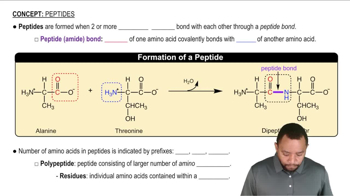
Connect the amino acids in the given sequence (Arg-Pro-Pro-Gly-Phe-Ser-Pro-Phe-Arg) using peptide bonds. A peptide bond is formed by a condensation reaction between the carboxyl group of one amino acid and the amino group of the next, releasing a molecule of water (H₂O).
For each amino acid, include its specific side chain (R group) in the structure. For example, arginine (Arg) has a guanidino group, proline (Pro) has a cyclic structure, glycine (Gly) has a hydrogen atom as its side chain, phenylalanine (Phe) has a benzyl group, and serine (Ser) has a hydroxymethyl group.
Ensure the structure starts with a free amino group (-NH₂) at the N-terminus (arginine) and ends with a free carboxyl group (-COOH) at the C-terminus (arginine). Verify that all atoms are correctly bonded and that the structure reflects the sequence provided.

Verified video answer for a similar problem:

This video solution was recommended by our tutors as helpful for the problem above.
Was this helpful?

Key Concepts

Here are the essential concepts you must grasp in order to answer the question correctly.

Peptide Structure

Peptides are short chains of amino acids linked by peptide bonds. The primary structure of a peptide, like bradykinin, refers to the specific sequence of amino acids that determines its unique properties and functions. Understanding how to represent this sequence in a structural formula is essential for visualizing the molecule's composition.
Recommended video:
Guided course
3:07
Peptides Concept 1

Amino Acids

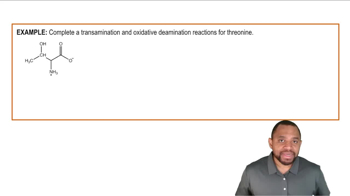
Amino acids are the building blocks of peptides and proteins, each characterized by a central carbon atom, an amino group, a carboxyl group, and a unique side chain (R group). The sequence and properties of these amino acids influence the peptide's structure and biological activity. In bradykinin, the specific arrangement of its amino acids is crucial for its role in regulating blood pressure.
Recommended video:
Guided course
3:03
Amino Acid Catabolism: Amino Group Example 2

Structural Formula Representation

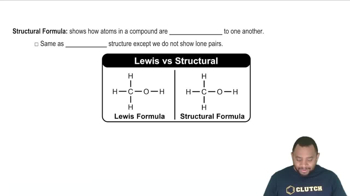
The structural formula of a molecule provides a visual representation of its atomic arrangement and bonding. For peptides, this includes depicting the backbone of amino acids and the side chains. Accurately drawing the structural formula of bradykinin involves illustrating the peptide bonds between amino acids and the functional groups that contribute to its biological function.
Recommended video:
Guided course
1:01
Structural Formula Concept 2