Pearson+ LogoPearson+ Logo
Ch.18 Amino Acids and Proteins
McMurry - Fundamentals of GOB 8th Edition
McMurry8th EditionFundamentals of GOBISBN: 9780134015187Not the one you use?Change textbook
Chapter 18, Problem 41a

What kind of biological function would each of the following proteins perform?
a. Human growth hormone

Verified step by step guidance
1
Understand the role of human growth hormone (HGH): Human growth hormone is a protein-based hormone that is secreted by the pituitary gland. It plays a critical role in growth, cell reproduction, and cell regeneration in humans.
Identify the biological function: HGH stimulates growth in tissues, including bone and muscle, by promoting the production of insulin-like growth factor 1 (IGF-1) in the liver and other tissues.
Explain its role in metabolism: HGH also helps regulate metabolism by influencing the breakdown of fats (lipolysis) and the utilization of glucose, ensuring energy is available for growth and repair processes.
Discuss its importance in development: During childhood and adolescence, HGH is essential for normal physical development, including increasing height and muscle mass.
Highlight its role in repair and maintenance: In adults, HGH contributes to tissue repair, muscle maintenance, and overall metabolic health, making it vital throughout life.

Verified video answer for a similar problem:

This video solution was recommended by our tutors as helpful for the problem above.
Was this helpful?

Key Concepts

Here are the essential concepts you must grasp in order to answer the question correctly.

Human Growth Hormone (HGH)

Human Growth Hormone (HGH) is a peptide hormone produced by the pituitary gland that plays a crucial role in growth, metabolism, and body composition. It stimulates growth in tissues, including bones and muscles, and regulates various metabolic processes, such as fat breakdown and protein synthesis. HGH is essential for normal physical development during childhood and adolescence.
Recommended video:
Guided course
3:52
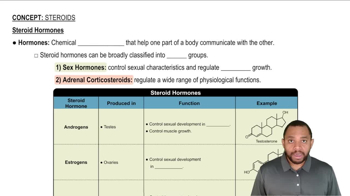
Steroids Concept 4

Endocrine System

The endocrine system is a network of glands that produce and secrete hormones directly into the bloodstream to regulate various bodily functions. This system controls processes such as growth, metabolism, and mood through hormones like HGH. Understanding the endocrine system is vital for comprehending how hormones interact and influence physiological functions.
Recommended video:
Guided course
01:18
First Law of Thermodynamics

Hormonal Regulation

Hormonal regulation refers to the mechanisms by which hormones control and coordinate physiological processes in the body. This includes feedback loops that maintain homeostasis, such as the regulation of growth and metabolism by HGH. Hormonal regulation is essential for understanding how proteins like HGH exert their biological effects and maintain balance within the body.
Recommended video:
Guided course
2:57
Allosteric Control Concept 1