
Pearson+ LogoPearson+ Logo
Ch.20 Carbohydrates
McMurry - Fundamentals of GOB 8th Edition
McMurry8th EditionFundamentals of GOBISBN: 9780134015187Not the one you use?Change textbook
Chapter 20, Problem 22a

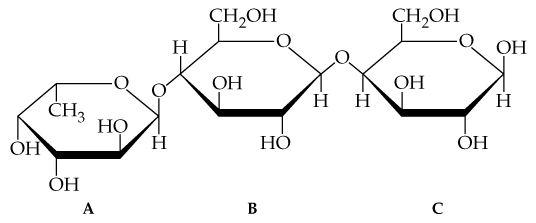
Consider the trisaccharide A, B, C shown in Problem 20.23.

a. Identify the hemiacetal and acetal linkages.

Verified step by step guidance
1
Step 1: Understand the structure of a hemiacetal and an acetal. A hemiacetal contains a carbon atom bonded to one -OH group and one -OR group, while an acetal contains a carbon atom bonded to two -OR groups.
Step 2: Examine the structure of the trisaccharide provided in Problem 20.23.a. Identify the carbon atoms that are part of glycosidic linkages, as these are potential sites for acetal or hemiacetal formations.
Step 3: For each glycosidic linkage, determine whether the carbon atom involved is bonded to one -OH group and one -OR group (hemiacetal) or two -OR groups (acetal).
Step 4: Identify the anomeric carbon atoms in the monosaccharide units. The anomeric carbon is the carbon derived from the carbonyl group (C=O) of the sugar and is typically involved in forming glycosidic bonds.
Step 5: Label each linkage in the trisaccharide as either a hemiacetal or an acetal based on the bonding pattern of the anomeric carbon atoms identified in the previous steps.

Verified video answer for a similar problem:

This video solution was recommended by our tutors as helpful for the problem above.
Video duration:
2m
Was this helpful?

Key Concepts

Here are the essential concepts you must grasp in order to answer the question correctly.

Hemiacetal Linkage

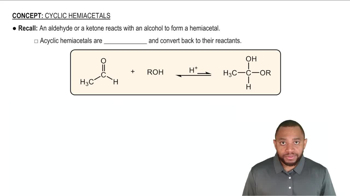
A hemiacetal linkage forms when an aldehyde reacts with an alcohol, resulting in a compound that contains both an alcohol and an ether functional group. In the context of carbohydrates, hemiacetals are typically formed when a monosaccharide's carbonyl group reacts with one of its hydroxyl groups, leading to a cyclic structure. This linkage is crucial for understanding the reactivity and stability of sugars.
Recommended video:
Guided course
2:10
Cyclic Hemiacetals Concept 1

Acetal Linkage

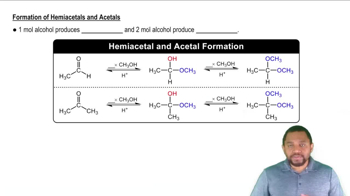
An acetal linkage occurs when a hemiacetal reacts with another alcohol, resulting in a compound with two ether groups. In carbohydrates, acetal linkages are formed during the glycosidic bond formation between monosaccharides, which is essential for creating disaccharides and polysaccharides. This linkage is important for the structural integrity and function of complex carbohydrates.
Recommended video:
Guided course
2:17
Formation of Hemiacetals and Acetals Concept 2

Glycosidic Bond

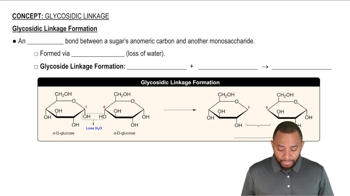
A glycosidic bond is a type of covalent bond that connects two monosaccharides through an acetal linkage, specifically between the anomeric carbon of one sugar and a hydroxyl group of another. This bond is pivotal in carbohydrate chemistry as it determines the structure and properties of oligosaccharides and polysaccharides. Understanding glycosidic bonds is essential for analyzing the formation and breakdown of carbohydrates in biological systems.
Recommended video:
Guided course
1:44
Glycosidic Linkage Formation Concept 1