Pearson+ LogoPearson+ Logo
Ch.20 Carbohydrates
McMurry - Fundamentals of GOB 8th Edition
McMurry8th EditionFundamentals of GOBISBN: 9780134015187Not the one you use?Change textbook
Chapter 20, Problem 21

Identify the following as diastereomers, enantiomers, and/or anomers.
(a) β-D-fructose and β-D-fructose
(b) D-galactose and L-galactose
(c) L-allose and D-glucose (both aldohexoses)

Verified step by step guidance
1
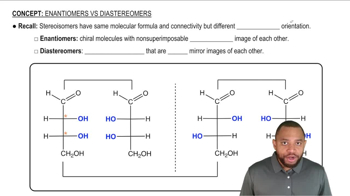
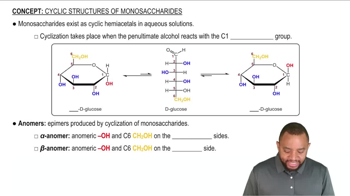
Step 1: Understand the definitions of the terms. Diastereomers are stereoisomers that are not mirror images of each other. Enantiomers are stereoisomers that are non-superimposable mirror images. Anomers are a specific type of diastereomer that differ in configuration at the anomeric carbon (the carbon derived from the carbonyl group in a sugar).
Step 2: Analyze part (a). Compare ß-d-fructose and ß-d-fructose. Since they are the same molecule, they are neither diastereomers, enantiomers, nor anomers. They are identical.
Step 3: Analyze part (b). Compare d-galactose and l-galactose. These are mirror images of each other and are non-superimposable. Therefore, they are enantiomers.
Step 4: Analyze part (c). Compare l-allose and d-glucose. Both are aldohexoses, but they differ in the arrangement of groups at multiple chiral centers. Since they are not mirror images, they are diastereomers.
Step 5: Summarize the findings. (a) Identical molecules, not diastereomers, enantiomers, or anomers. (b) Enantiomers. (c) Diastereomers.

Verified video answer for a similar problem:

This video solution was recommended by our tutors as helpful for the problem above.
Video duration:
6m
Was this helpful?

Key Concepts

Here are the essential concepts you must grasp in order to answer the question correctly.

Diastereomers

Diastereomers are stereoisomers that are not mirror images of each other. They occur when two or more stereocenters are present in a molecule, leading to different spatial arrangements of atoms. Unlike enantiomers, which have identical physical properties except for their interaction with polarized light, diastereomers can have significantly different chemical and physical properties.
Recommended video:
Guided course
3:33
Enantiomers vs Diastereomers Concept 1

Enantiomers

Enantiomers are a type of stereoisomer that are non-superimposable mirror images of each other. Each enantiomer has at least one chiral center, and they often exhibit different optical activities, meaning they rotate plane-polarized light in opposite directions. Enantiomers can have vastly different biological activities, making their distinction crucial in fields like pharmacology.
Recommended video:
Guided course
3:33
Enantiomers vs Diastereomers Concept 1

Anomers

Anomers are a specific type of stereoisomer that differ at the anomeric carbon, which is the carbon atom that becomes a new chiral center when a sugar cyclizes. In the case of carbohydrates, anomers are typically designated as alpha (α) or beta (β) based on the orientation of the hydroxyl group at the anomeric carbon. This distinction is important in understanding the reactivity and properties of sugars in biological systems.
Recommended video:
Guided course
2:49
Cyclic Structures of Monosaccharides Concept 1