Pearson+ LogoPearson+ Logo
Ch.20 Carbohydrates
McMurry - Fundamentals of GOB 8th Edition
McMurry8th EditionFundamentals of GOBISBN: 9780134015187Not the one you use?Change textbook
Chapter 20, Problem 14

Draw the structure of the α and β anomers that result from the reaction of methanol and ribose. Are these compounds acetals or hemiacetals?

Verified step by step guidance
1
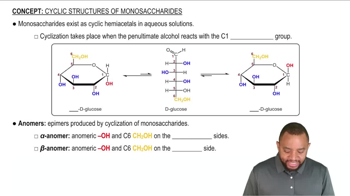
Understand the context: Ribose is a monosaccharide (a sugar) that can exist in a cyclic form. When it reacts with methanol, it forms two different stereoisomers called anomers (α and ß). These anomers differ in the orientation of the substituent at the anomeric carbon (C1).
Identify the reaction type: The reaction between ribose and methanol involves the formation of a glycosidic bond. This occurs at the anomeric carbon (C1) of ribose, where the hydroxyl group (-OH) reacts with methanol (CH₃OH). The product can either be an acetal or a hemiacetal depending on the structure.
Draw the cyclic structure of ribose: Ribose typically forms a five-membered ring (furanose form) in its cyclic structure. Label the anomeric carbon (C1) and the hydroxyl groups on the other carbons (C2, C3, C4).
Illustrate the reaction with methanol: Replace the hydroxyl group (-OH) at the anomeric carbon (C1) with a methoxy group (-OCH₃). This substitution creates two possible stereoisomers: the α-anomer (where the -OCH₃ group is trans to the CH₂OH group at C4) and the ß-anomer (where the -OCH₃ group is cis to the CH₂OH group at C4).
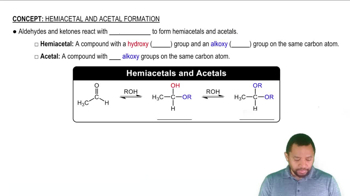
Classify the products: Since the hydroxyl group at the anomeric carbon is replaced by a methoxy group, the products are acetals, not hemiacetals. Acetals are characterized by having two -OR groups attached to the same carbon, whereas hemiacetals have one -OH and one -OR group.

Verified video answer for a similar problem:

This video solution was recommended by our tutors as helpful for the problem above.
Video duration:
4m
Was this helpful?

Key Concepts

Here are the essential concepts you must grasp in order to answer the question correctly.

Anomers

Anomers are a type of stereoisomer that differ in configuration at the anomeric carbon, which is the carbon derived from the carbonyl carbon of a sugar. In the case of ribose, the α and ß anomers refer to the orientation of the hydroxyl group attached to the anomeric carbon (C1) when the sugar is in its cyclic form. The α anomer has the hydroxyl group pointing down, while the ß anomer has it pointing up.
Recommended video:
Guided course
2:49
Cyclic Structures of Monosaccharides Concept 1

Acetals and Hemiacetals

Hemiacetals and acetals are types of organic compounds formed from the reaction of alcohols with aldehydes or ketones. A hemiacetal contains one -OH group and one -OR group attached to the same carbon, while an acetal has two -OR groups. In the context of ribose reacting with methanol, the resulting products can be classified as hemiacetals if they contain one -OH and one -OCH3 group, or as acetals if they contain two -OCH3 groups.
Recommended video:
Guided course
1:49
Hemiacetals and Acetals Concept 1

Ribose Structure

Ribose is a five-carbon sugar (pentose) that plays a crucial role in biochemistry, particularly in the structure of RNA. It can exist in both linear and cyclic forms, with the cyclic form being more stable in solution. Understanding the structure of ribose, including its anomeric carbon and the potential for reactions with alcohols like methanol, is essential for predicting the products of such reactions and their classification as hemiacetals or acetals.
Recommended video:
Guided course
1:01
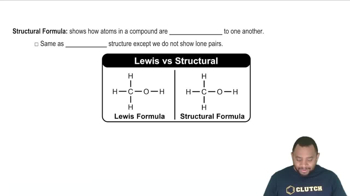
Structural Formula Concept 2