Pearson+ LogoPearson+ Logo
Ch.20 Carbohydrates
McMurry - Fundamentals of GOB 8th Edition
McMurry8th EditionFundamentals of GOBISBN: 9780134015187Not the one you use?Change textbook
Chapter 20, Problem 55

Oxidation of the aldehyde group of ribose yields a carboxylic acid. Draw the structure of ribonic acid.

Verified step by step guidance
1
Understand the problem: The oxidation of an aldehyde group (-CHO) in a sugar like ribose converts it into a carboxylic acid group (-COOH). This process forms a sugar acid, specifically ribonic acid in this case.
Start with the structure of ribose: Ribose is a five-carbon sugar (a pentose) with the molecular formula C₅H₁₀O₅. It contains an aldehyde group (-CHO) at the first carbon (C1) and hydroxyl groups (-OH) attached to the other carbons.
Identify the site of oxidation: The aldehyde group (-CHO) at the first carbon (C1) is the functional group that will be oxidized. Oxidation of an aldehyde involves the addition of an oxygen atom, converting it into a carboxylic acid group (-COOH).
Modify the structure: Replace the aldehyde group (-CHO) at C1 of ribose with a carboxylic acid group (-COOH). The rest of the ribose structure, including the hydroxyl groups on the other carbons, remains unchanged.
Draw the final structure: The resulting molecule, ribonic acid, will have the following structure: a carboxylic acid group (-COOH) at C1, hydroxyl groups (-OH) on C2, C3, and C4, and a primary alcohol (-CH₂OH) at C5. Ensure the stereochemistry of the hydroxyl groups matches that of ribose.

Verified video answer for a similar problem:

This video solution was recommended by our tutors as helpful for the problem above.
Video duration:
1m
Was this helpful?

Key Concepts

Here are the essential concepts you must grasp in order to answer the question correctly.

Aldehyde Functional Group

An aldehyde is a functional group characterized by a carbon atom bonded to a hydrogen atom and a double bond to an oxygen atom (C=O). In ribose, the aldehyde group is located at the first carbon, making it an aldopentose. Understanding this structure is crucial for recognizing how oxidation can transform the aldehyde into a carboxylic acid.
Recommended video:
Guided course
1:11
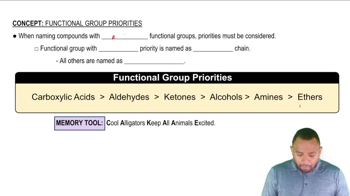
Functional Group Priorities Concept 1

Oxidation Reaction

Oxidation is a chemical reaction that involves the loss of electrons or an increase in oxidation state. In the context of ribose, the oxidation of the aldehyde group results in the formation of a carboxylic acid, specifically ribonic acid. This transformation is essential for understanding how carbohydrates can be modified and their functional implications in biochemistry.
Recommended video:
Guided course
1:32
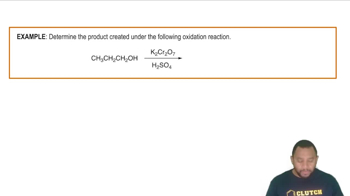
Alcohol Reactions Oxidation Reactions Example 1

Carboxylic Acid Structure

Carboxylic acids are organic compounds that contain a carboxyl group (-COOH), which consists of a carbon atom double-bonded to an oxygen atom and single-bonded to a hydroxyl group (OH). In ribonic acid, the carboxylic acid group replaces the aldehyde group of ribose, altering its chemical properties and reactivity. Recognizing this structure is vital for drawing the correct molecular representation of ribonic acid.
Recommended video:
Guided course
1:09
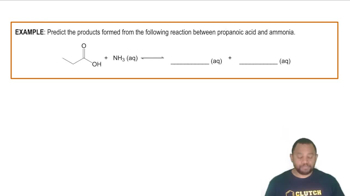
Carboxylic Acid Reactions Example 1