
Textbook Question
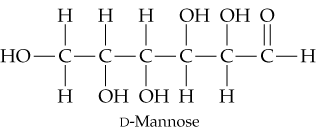
Oxidation of the aldehyde group of ribose yields a carboxylic acid. Draw the structure of ribonic acid.
642
views

 Verified step by step guidance
 1:44
1:44
 0:56
0:56 08:01
08:01Oxidation of the aldehyde group of ribose yields a carboxylic acid. Draw the structure of ribonic acid.
Amylose (a form of starch) and cellulose are both polymers of glucose. What is the main structural difference between them? What roles do these two polymers have in nature?
Reduction of D-fructose with a reducing agent yields a mixture of D-sorbitol along with a second, isomeric product. What is the structure of the second product?
Treatment of an aldose with an oxidizing agent such as Tollens’ reagent yields a carboxylic acid. Gluconic acid, the product of glucose oxidation, is used as its magnesium salt for the treatment of magnesium deficiency. Draw the structure of gluconic acid.
Draw a disaccharide of two cyclic mannose molecules attached by an α-1,4 glycosidic linkage. Explain why the glycosidic products in Problem 20.58 are not reducing sugars, but the product in this problem is a reducing sugar.
Lactose and maltose are reducing disaccharides, but sucrose is a nonreducing disaccharide. Explain.