Pearson+ LogoPearson+ Logo
Ch.20 Carbohydrates
McMurry - Fundamentals of GOB 8th Edition
McMurry8th EditionFundamentals of GOBISBN: 9780134015187Not the one you use?Change textbook
Chapter 20, Problem 59

Draw a disaccharide of two cyclic mannose molecules attached by an α-1,4 glycosidic linkage. Explain why the glycosidic products in Problem 20.58 are not reducing sugars, but the product in this problem is a reducing sugar.

Verified step by step guidance
1
Step 1: Understand the structure of mannose. Mannose is a hexose sugar with the molecular formula C₆H₁₂O₆. In its cyclic form, it exists as a six-membered ring (pyranose) with an anomeric carbon at position 1. The α-anomer has the hydroxyl group on the anomeric carbon pointing down relative to the ring plane.
Step 2: Draw two cyclic mannose molecules. Represent each mannose molecule in its pyranose form, ensuring that the anomeric carbon (C1) is clearly labeled. For the first mannose molecule, use the α-anomer configuration.
Step 3: Form the α-1,4 glycosidic linkage. Connect the anomeric carbon (C1) of the first mannose molecule to the hydroxyl group on carbon 4 (C4) of the second mannose molecule. This bond is called an α-1,4 glycosidic linkage because the linkage involves the α-anomer of the first mannose and the C4 position of the second mannose.
Step 4: Explain why the product is a reducing sugar. A reducing sugar has a free anomeric carbon that can open to form an aldehyde group. In this disaccharide, the second mannose molecule retains its free anomeric carbon (C1), which is not involved in the glycosidic bond. This allows the second mannose to act as a reducing sugar.
Step 5: Contrast with Problem 20.58. In Problem 20.58, the glycosidic products are not reducing sugars because all anomeric carbons are involved in glycosidic bonds, leaving no free anomeric carbon to open and form an aldehyde group. This structural difference explains why the disaccharide in this problem is a reducing sugar, while the products in Problem 20.58 are not.

Verified video answer for a similar problem:

This video solution was recommended by our tutors as helpful for the problem above.
Video duration:
2m
Was this helpful?

Key Concepts

Here are the essential concepts you must grasp in order to answer the question correctly.

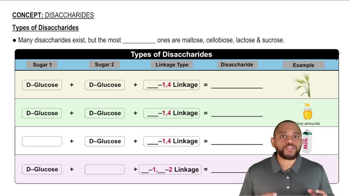
Disaccharides

Disaccharides are carbohydrates formed by the condensation of two monosaccharides, resulting in a glycosidic bond. In this case, the disaccharide consists of two cyclic mannose molecules linked by an α-1,4 glycosidic bond. This structure is crucial for understanding how sugars can vary in their properties, including their ability to act as reducing or non-reducing sugars.
Recommended video:
Guided course
3:39
Types of Disaccharides Concept 1

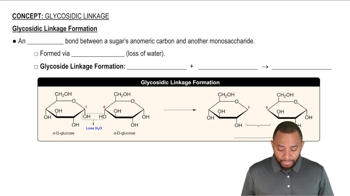
Glycosidic Linkage

A glycosidic linkage is a covalent bond that connects a carbohydrate molecule to another group, which can be another carbohydrate. The type of glycosidic bond (e.g., α or β) influences the sugar's reactivity and properties. In this context, the α-1,4 glycosidic linkage allows the disaccharide to retain a free anomeric carbon, which is essential for its classification as a reducing sugar.
Recommended video:
Guided course
1:44
Glycosidic Linkage Formation Concept 1

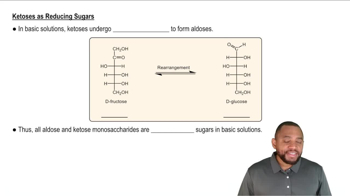
Reducing Sugars

Reducing sugars are carbohydrates that can donate electrons to other molecules, typically due to the presence of a free aldehyde or ketone group. In the case of the disaccharide formed from mannose, the free anomeric carbon allows it to act as a reducing sugar. In contrast, glycosidic products that do not have a free anomeric carbon are classified as non-reducing sugars, as they cannot participate in redox reactions.
Recommended video:
Guided course
1:03
Ketoses as Reducing Sugars Concept 2