Pearson+ LogoPearson+ Logo
Ch.21 The Generation of Biochemical Energy
McMurry - Fundamentals of GOB 8th Edition
McMurry8th EditionFundamentals of GOBISBN: 9780134015187Not the one you use?Change textbook
Chapter 21, Problem 42

What key metabolic intermediate is formed from the catabolism of all three major classes of foods: carbohydrates, lipids, and proteins?

Verified step by step guidance
1
Understand that the question is asking for a common metabolic intermediate that is produced during the breakdown (catabolism) of carbohydrates, lipids, and proteins.
Recall that carbohydrates are broken down into glucose, which undergoes glycolysis to form pyruvate. Pyruvate is then converted into acetyl-CoA during the transition step before entering the citric acid cycle.
Recognize that lipids (fats) are broken down into glycerol and fatty acids. Fatty acids undergo beta-oxidation, a process that produces acetyl-CoA as the main product.
Understand that proteins are broken down into amino acids, which can be deaminated to remove the amino group. The remaining carbon skeletons of amino acids can be converted into various intermediates, including acetyl-CoA, depending on the amino acid.
Conclude that acetyl-CoA is the key metabolic intermediate formed from the catabolism of carbohydrates, lipids, and proteins, as it serves as a central molecule that enters the citric acid cycle for further energy production.

Verified video answer for a similar problem:

This video solution was recommended by our tutors as helpful for the problem above.
Video duration:
1m
Was this helpful?

Key Concepts

Here are the essential concepts you must grasp in order to answer the question correctly.

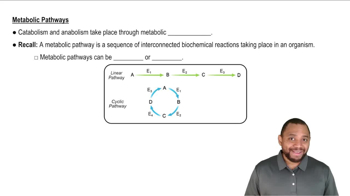
Metabolism

Metabolism refers to the set of life-sustaining chemical reactions in organisms that convert food into energy. It encompasses two main processes: catabolism, which breaks down molecules to release energy, and anabolism, which uses energy to construct components of cells. Understanding metabolism is crucial for grasping how different nutrients are processed in the body.
Recommended video:
Guided course
0:52
Metabolic Pathways Concept 2

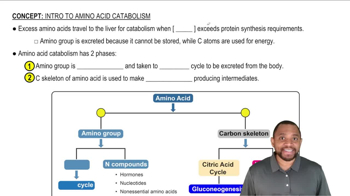
Catabolism

Catabolism is the metabolic pathway that breaks down molecules into smaller units, releasing energy in the process. This process is essential for the conversion of macronutrients—carbohydrates, lipids, and proteins—into usable energy forms. The end products of catabolism are vital for various cellular functions and energy production.
Recommended video:
Guided course
2:06
Intro to Amino Acid Catabolism Concept 1

Acetyl-CoA

Acetyl-CoA is a key metabolic intermediate that plays a central role in energy production. It is formed from the breakdown of carbohydrates, fats, and proteins, serving as a critical substrate for the citric acid cycle (Krebs cycle). Acetyl-CoA is essential for the synthesis of fatty acids and cholesterol, making it a pivotal molecule in metabolism.
Recommended video:
Guided course
1:33
Phase B - Succinyl CoA Formation Example 2