Pearson+ LogoPearson+ Logo
Ch.21 The Generation of Biochemical Energy
McMurry - Fundamentals of GOB 8th Edition
McMurry8th EditionFundamentals of GOBISBN: 9780134015187Not the one you use?Change textbook
Chapter 21, Problem 43

Why is ATP sometimes called a high-energy molecule?

Verified step by step guidance
1
ATP (adenosine triphosphate) is called a high-energy molecule because it contains three phosphate groups linked by phosphoanhydride bonds, which are high-energy bonds due to the repulsion between negatively charged phosphate groups.
When one of these bonds is broken, typically the bond between the second and third phosphate groups, a large amount of energy is released. This process is represented by the reaction: ATP → ADP + Pi + energy, where ADP is adenosine diphosphate and Pi is inorganic phosphate.
The energy released during the hydrolysis of ATP is used to power various biological processes, such as muscle contraction, active transport across cell membranes, and chemical synthesis.
The high-energy nature of ATP is not due to the bond itself being inherently 'high-energy,' but rather because the products of the reaction (ADP and Pi) are more stable than ATP, making the reaction highly exergonic (energy-releasing).
This property of ATP makes it an essential energy currency in cells, allowing it to store and transfer energy efficiently for cellular activities.

Verified video answer for a similar problem:

This video solution was recommended by our tutors as helpful for the problem above.
Video duration:
1m
Was this helpful?

Key Concepts

Here are the essential concepts you must grasp in order to answer the question correctly.

Adenosine Triphosphate (ATP)

ATP, or adenosine triphosphate, is a nucleotide that serves as the primary energy carrier in cells. It consists of an adenosine molecule bonded to three phosphate groups. The energy stored in ATP is released when the terminal phosphate group is hydrolyzed, making it crucial for various cellular processes.
Recommended video:
Guided course
1:03
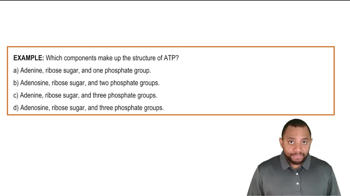
Adenosine Triphosphate (ATP) Example 2

Phosphate Bonds

The bonds between the phosphate groups in ATP are known as high-energy bonds. When these bonds are broken, particularly the bond between the second and third phosphate groups, a significant amount of energy is released. This energy is utilized by cells to perform work, such as muscle contraction and biochemical reactions.
Recommended video:

Energy Transfer in Cells

ATP is often referred to as a high-energy molecule because it plays a vital role in energy transfer within cells. The energy released from ATP hydrolysis is harnessed to drive endergonic reactions, which require energy input. This makes ATP essential for maintaining cellular functions and supporting life processes.
Recommended video:
Guided course
0:50
Cell Membranes Concept 1