Pearson+ LogoPearson+ Logo
Ch.21 The Generation of Biochemical Energy
McMurry - Fundamentals of GOB 8th Edition
McMurry8th EditionFundamentals of GOBISBN: 9780134015187Not the one you use?Change textbook
Chapter 21, Problem 45

What does it mean when we say that two reactions are coupled?

Verified step by step guidance
1
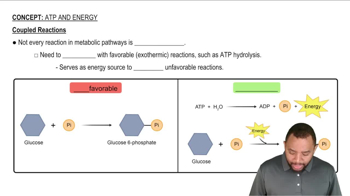
When we say that two reactions are coupled, it means that the energy released by one reaction is used to drive another reaction that would not occur spontaneously on its own.
In biochemical systems, this often involves pairing an exergonic reaction (one that releases energy, such as the hydrolysis of ATP) with an endergonic reaction (one that requires energy input).
The coupling occurs through a shared intermediate or a direct transfer of energy, such as the transfer of a phosphate group in ATP hydrolysis.
This process allows cells to perform work, such as synthesizing molecules, transporting substances, or contracting muscles, by harnessing the energy from favorable reactions.
An example of coupled reactions is the synthesis of glucose-6-phosphate from glucose and ATP, where the energy from ATP hydrolysis is used to phosphorylate glucose.

Verified video answer for a similar problem:

This video solution was recommended by our tutors as helpful for the problem above.
Video duration:
2m
Was this helpful?

Key Concepts

Here are the essential concepts you must grasp in order to answer the question correctly.

Coupled Reactions

Coupled reactions refer to a process where two chemical reactions occur simultaneously, with the energy released from one reaction driving the other. This is often seen in biological systems, where exergonic reactions (releasing energy) are paired with endergonic reactions (requiring energy) to facilitate essential cellular processes.
Recommended video:
Guided course
1:46
Coupled Reactions Concept 3

Thermodynamics

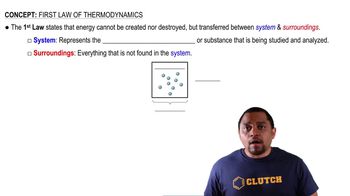
Thermodynamics is the study of energy transformations and the laws governing these processes. In the context of coupled reactions, the first law of thermodynamics states that energy cannot be created or destroyed, which means the energy released from one reaction can be harnessed to power another, maintaining the overall energy balance in a system.
Recommended video:
Guided course
01:18
First Law of Thermodynamics

Biochemical Pathways

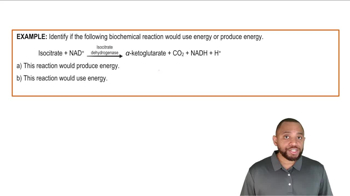
Biochemical pathways are sequences of chemical reactions occurring within a cell, often involving multiple coupled reactions. These pathways are crucial for metabolism, as they allow cells to efficiently convert substrates into products, utilizing energy from exergonic reactions to drive necessary endergonic reactions, thus supporting life processes.
Recommended video:
Guided course
1:08
Energy Production In Biochemical Pathways Example 1