Fatty acids from stored triacylglycerols (fat) are not available for gluconeogenesis. Speculate why we do not have the enzymes to directly convert fatty acids into glucose. Plants (especially seeds) do have enzymes to convert fatty acids into carbohydrates. Why are they so lucky?
Ch.22 Carbohydrate Metabolism
Chapter 22, Problem 34
What are the products of digestion of proteins, triacylglycerols, maltose, sucrose, lactose, and starch?
Verified step by step guidance1
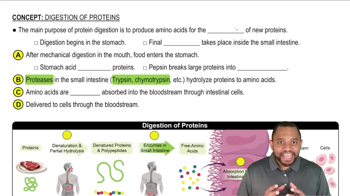
Proteins are broken down into their building blocks, amino acids, through the process of hydrolysis. Enzymes like pepsin in the stomach and trypsin in the small intestine catalyze this reaction.
Triacylglycerols (fats) are digested into glycerol and free fatty acids. This process is facilitated by the enzyme lipase, which breaks the ester bonds in the triacylglycerol molecules.
Maltose, a disaccharide composed of two glucose units, is hydrolyzed into two glucose molecules by the enzyme maltase.
Sucrose, a disaccharide made of glucose and fructose, is broken down into one glucose molecule and one fructose molecule by the enzyme sucrase.
Lactose, a disaccharide consisting of glucose and galactose, is hydrolyzed into one glucose molecule and one galactose molecule by the enzyme lactase. Starch, a polysaccharide, is broken down into maltose and eventually into glucose by the enzyme amylase.

Verified video answer for a similar problem:
This video solution was recommended by our tutors as helpful for the problem above.
Video duration:
4mWas this helpful?
Key Concepts
Here are the essential concepts you must grasp in order to answer the question correctly.
Protein Digestion
Protein digestion involves breaking down proteins into smaller peptides and amino acids through the action of enzymes like pepsin in the stomach and trypsin in the small intestine. This process is essential for the body to utilize amino acids for various functions, including tissue repair and enzyme production.
Recommended video:
Guided course
Digestion of Proteins Concept 1
Lipid Digestion
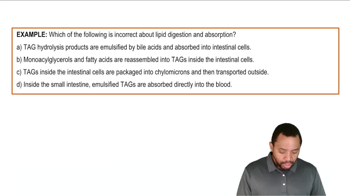
Triacylglycerols, or triglycerides, are digested primarily in the small intestine, where bile salts emulsify fats, allowing pancreatic lipase to break them down into free fatty acids and glycerol. These products are then absorbed into the bloodstream for energy or storage.
Recommended video:
Guided course
Digestion of Lipids Example 1
Carbohydrate Digestion
Carbohydrates like maltose, sucrose, lactose, and starch are digested into simple sugars. Enzymes such as amylase break down starch into maltose, while maltase, sucrase, and lactase further convert disaccharides into monosaccharides like glucose, fructose, and galactose, which are readily absorbed by the body.
Recommended video:
Guided course
Digestion of Lipids Example 1
Related Practice
Textbook Question
595
views
Textbook Question
The pathway that converts glucose to acetyl-CoA is often referred to as an “aerobic oxidation pathway.”
(b) Thinking back to Chapter 20, where does molecular oxygen enter the picture?
885
views
Textbook Question
What are the major monosaccharide products produced by digestion of carbohydrates?
747
views
Textbook Question
What three products are formed from pyruvate under aerobic, anaerobic, and fermentation conditions?
750
views
Textbook Question
What is the major purpose of the pentose phosphate pathway? What cofactor (coenzyme) is used?

Textbook Question
Which cells, liver, muscle, or brain, use the following pathways?
a. Glycolysis
1105
views