Pearson+ LogoPearson+ Logo
Ch.22 Carbohydrate Metabolism
McMurry - Fundamentals of GOB 8th Edition
McMurry8th EditionFundamentals of GOBISBN: 9780134015187Not the one you use?Change textbook
Chapter 22, Problem 29

Fatty acids from stored triacylglycerols (fat) are not available for gluconeogenesis. Speculate why we do not have the enzymes to directly convert fatty acids into glucose. Plants (especially seeds) do have enzymes to convert fatty acids into carbohydrates. Why are they so lucky?

Verified step by step guidance
1
Understand the biochemical pathways involved: Fatty acids are broken down through a process called β-oxidation, which generates acetyl-CoA. Acetyl-CoA enters the citric acid cycle (Krebs cycle) but cannot be directly converted into glucose because humans lack the necessary enzymes to convert acetyl-CoA into pyruvate or other gluconeogenic intermediates.
Recognize the limitation in humans: The gluconeogenesis pathway in humans relies on intermediates like pyruvate, oxaloacetate, and glycerol. Acetyl-CoA, derived from fatty acids, is not a substrate for gluconeogenesis because the conversion of acetyl-CoA to oxaloacetate is not thermodynamically favorable and lacks enzymatic support in humans.
Consider the evolutionary perspective: Humans and animals have evolved to store energy in the form of triacylglycerols (fats) for long-term energy needs and glycogen for short-term glucose supply. This division of energy storage reduces the need for converting fatty acids into glucose, as fats are primarily used for energy production rather than glucose synthesis.
Compare with plants: Plants, especially seeds, have enzymes like the glyoxylate cycle that allow them to bypass the decarboxylation steps of the citric acid cycle. This enables them to convert acetyl-CoA into intermediates like succinate, which can then be used for gluconeogenesis to produce carbohydrates. This adaptation is crucial for seeds, as they rely on stored fats to generate energy and structural carbohydrates during germination.
Summarize the functional differences: Humans prioritize efficient energy storage and utilization, while plants, particularly seeds, need the ability to convert stored fats into carbohydrates to support growth and development. This difference in metabolic pathways reflects the distinct energy needs and survival strategies of animals and plants.

Verified video answer for a similar problem:

This video solution was recommended by our tutors as helpful for the problem above.
Video duration:
4m
Was this helpful?

Key Concepts

Here are the essential concepts you must grasp in order to answer the question correctly.

Gluconeogenesis

Gluconeogenesis is the metabolic pathway that generates glucose from non-carbohydrate substrates, primarily occurring in the liver and kidneys. This process is crucial for maintaining blood glucose levels during fasting or intense exercise. It primarily utilizes precursors like lactate, glycerol, and certain amino acids, but not fatty acids, which lack the necessary carbon skeleton for glucose synthesis.
Recommended video:
Guided course
1:23
Gluconeogenesis Example 2

Fatty Acid Metabolism

Fatty acid metabolism involves the breakdown of fatty acids for energy through processes like beta-oxidation, which converts fatty acids into acetyl-CoA. This acetyl-CoA can enter the citric acid cycle for energy production but cannot be converted back into glucose in animals. This limitation is due to the irreversible nature of certain steps in the citric acid cycle, which prevents the conversion of acetyl-CoA into glucose.
Recommended video:
Guided course
2:00
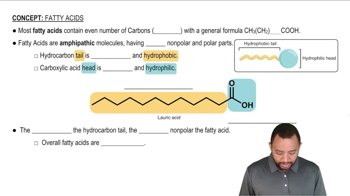
Fatty Acids Concept 1

Plant Metabolism and Glyoxylate Cycle

Plants, particularly seeds, possess the glyoxylate cycle, a metabolic pathway that allows them to convert fatty acids into carbohydrates. This cycle bypasses the decarboxylation steps of the citric acid cycle, enabling the conversion of acetyl-CoA into four-carbon compounds that can be further processed into glucose. This adaptation is essential for seed germination, providing energy and carbon sources when photosynthesis is not yet possible.
Recommended video:
Guided course
1:30
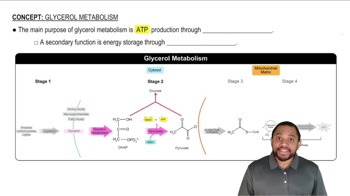
Glycerol Metabolism Concept 1