Pearson+ LogoPearson+ Logo
Ch.22 Carbohydrate Metabolism
McMurry - Fundamentals of GOB 8th Edition
McMurry8th EditionFundamentals of GOBISBN: 9780134015187Not the one you use?Change textbook
Chapter 22, Problem 30b

The pathway that converts glucose to acetyl-CoA is often referred to as an “aerobic oxidation pathway.”
(b) Thinking back to Chapter 20, where does molecular oxygen enter the picture?

Verified step by step guidance
1
Recall that the pathway converting glucose to acetyl-CoA involves glycolysis followed by the pyruvate dehydrogenase complex. Glycolysis occurs in the cytoplasm and does not directly involve oxygen, making it an anaerobic process.
Understand that molecular oxygen (O₂) is not directly involved in the conversion of glucose to acetyl-CoA. Instead, oxygen plays a critical role in the electron transport chain (ETC), which is part of aerobic respiration.
In Chapter 20, molecular oxygen enters the picture during the electron transport chain, which occurs in the mitochondria. Oxygen acts as the final electron acceptor in the chain, combining with electrons and protons to form water (H₂O).
Recognize that the electron transport chain is indirectly linked to the earlier steps of glucose metabolism. The NADH and FADH₂ produced during glycolysis, the pyruvate dehydrogenase complex, and the citric acid cycle donate electrons to the ETC, where oxygen is required.
Conclude that while molecular oxygen is not directly involved in the conversion of glucose to acetyl-CoA, it is essential for the continuation of aerobic respiration, as it allows the regeneration of NAD⁺ and FAD, which are necessary for glycolysis and the citric acid cycle to proceed.

Verified video answer for a similar problem:

This video solution was recommended by our tutors as helpful for the problem above.
Video duration:
4m
Was this helpful?

Key Concepts

Here are the essential concepts you must grasp in order to answer the question correctly.

Aerobic Oxidation

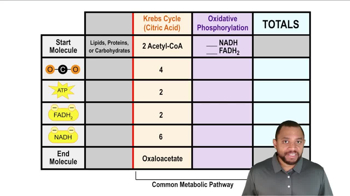
Aerobic oxidation is a metabolic process that requires oxygen to convert glucose into energy. This pathway involves glycolysis, the citric acid cycle, and oxidative phosphorylation, ultimately leading to the production of ATP. Oxygen serves as the final electron acceptor in the electron transport chain, allowing for efficient energy production.
Recommended video:
Guided course
2:46
Aerobic Respiration Summary Concept 1

Acetyl-CoA

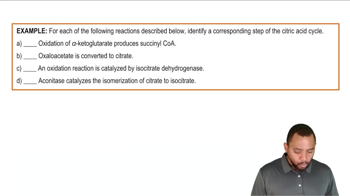
Acetyl-CoA is a crucial metabolic intermediate that plays a key role in energy production and biosynthesis. It is formed from the breakdown of carbohydrates, fats, and proteins and enters the citric acid cycle, where it is further oxidized to generate ATP. Understanding its formation from glucose is essential for grasping the aerobic oxidation pathway.
Recommended video:
Guided course
1:33
Phase B - Succinyl CoA Formation Example 2

Role of Molecular Oxygen

Molecular oxygen is vital in aerobic respiration as it facilitates the complete oxidation of glucose. It enters the metabolic pathway during the electron transport chain, where it accepts electrons and combines with protons to form water. This process not only drives ATP synthesis but also prevents the accumulation of electrons, maintaining the flow of the metabolic pathway.
Recommended video:
Guided course
02:08
Molecular Formula