A membrane lipid was isolated and completely hydrolyzed. The following products were detected: ethanolamine, phosphate, glycerol, palmitic acid, and oleic acid. Propose a structure for this membrane lipid, and name the family to which it belongs.
Ch.23 Lipids
Chapter 23, Problem 31
Are the carbon–carbon double bonds in naturally occurring fatty acids primarily cis or trans?
Verified step by step guidance1
Understand the structure of fatty acids: Fatty acids are long hydrocarbon chains with a carboxylic acid group (-COOH) at one end. Some fatty acids contain carbon–carbon double bonds, which can exist in either cis or trans configurations.
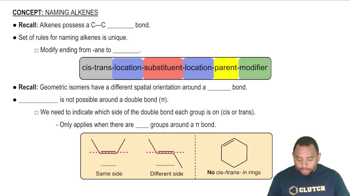
Define the cis and trans configurations: In a cis configuration, the hydrogen atoms attached to the carbon atoms of the double bond are on the same side of the molecule. In a trans configuration, the hydrogen atoms are on opposite sides of the molecule.
Recognize the natural occurrence of cis bonds: In naturally occurring unsaturated fatty acids, the carbon–carbon double bonds are predominantly in the cis configuration. This causes a bend or kink in the fatty acid chain, which affects the physical properties of the molecule.
Explain the significance of cis bonds: The cis configuration in natural fatty acids contributes to their liquid state at room temperature (e.g., oils) because the kinks prevent tight packing of the molecules.
Note the exception of trans fats: Trans double bonds are typically found in artificially hydrogenated fats and are less common in nature. These trans fats have a straighter structure, similar to saturated fats, and are associated with different health effects.

Verified video answer for a similar problem:
This video solution was recommended by our tutors as helpful for the problem above.
Video duration:
2mWas this helpful?
Key Concepts
Here are the essential concepts you must grasp in order to answer the question correctly.
Cis and Trans Isomerism
Cis and trans isomerism refers to the spatial arrangement of atoms in a molecule. In cis isomers, similar groups are on the same side of a double bond, while in trans isomers, they are on opposite sides. This difference in configuration can significantly affect the physical properties and biological functions of fatty acids.
Recommended video:
Guided course
Rules for Naming Alkenes Concept 1
Fatty Acid Structure
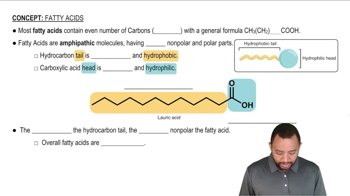
Fatty acids are carboxylic acids with long hydrocarbon chains, which can be saturated or unsaturated. Unsaturated fatty acids contain one or more double bonds between carbon atoms. The presence and configuration of these double bonds influence the melting point, fluidity, and overall function of the fatty acids in biological systems.
Recommended video:
Guided course
Fatty Acids Example 1
Biological Significance of Fatty Acids
The configuration of double bonds in fatty acids has important implications for health and nutrition. Cis fatty acids are typically found in natural fats and oils, contributing to fluidity in cell membranes, while trans fatty acids, often found in processed foods, are associated with negative health effects. Understanding these configurations helps in assessing dietary impacts on health.
Recommended video:
Guided course
Fatty Acids Concept 1
Related Practice
Textbook Question
761
views
Textbook Question
Draw an 18-carbon saturated fatty acid. Is this a “straight-chain” molecule or a “bent” molecule?
928
views
Textbook Question
Draw an 18-carbon unsaturated fatty acid that contains two carbon–carbon double bonds, one on carbon 6 and one on carbon 9 (count starting with the carboxyl carbon). Is this a “straight-chain” molecule or a “bent” molecule?
1111
views
Textbook Question
Which of these fatty acids has the lower melting point? Explain why.
a. Linoleic acid
b. Stearic acid
541
views
Textbook Question
Which of these fatty acids has the higher melting point? Explain why.
a. Linolenic acid
b. Stearic acid
803
views
Textbook Question
Draw the structure of glyceryl trilaurate, which is made from glycerol and three lauric acid molecules.
917
views