
Pearson+ LogoPearson+ Logo
Ch.23 Lipids
McMurry - Fundamentals of GOB 8th Edition
McMurry8th EditionFundamentals of GOBISBN: 9780134015187Not the one you use?Change textbook
Chapter 23, Problem 13b

Identify the products formed by complete hydrolysis of all ester bonds in (b) the sphingomyelin in Figure 23.5.

Verified step by step guidance
1
Identify the structure of sphingomyelin from Figure 23.5. Sphingomyelin is a type of sphingolipid that contains a sphingosine backbone, a fatty acid attached via an amide bond, and a phosphate group attached to a choline group.
Understand the concept of hydrolysis. Hydrolysis is a chemical reaction where water is used to break bonds. In the case of sphingomyelin, hydrolysis will break the ester bonds and the amide bond.
Focus on the ester bonds in sphingomyelin. These are found between the phosphate group and the choline group, as well as between the phosphate group and the sphingosine backbone. Hydrolysis of these bonds will yield choline, phosphate, and the sphingosine backbone.
Consider the amide bond between the sphingosine backbone and the fatty acid. Hydrolysis of this bond will release the fatty acid and the sphingosine backbone as separate products.
Combine the products from the hydrolysis reactions. The complete hydrolysis of sphingomyelin will yield choline, phosphate, a fatty acid, and sphingosine as the final products.

Verified video answer for a similar problem:

This video solution was recommended by our tutors as helpful for the problem above.
Video duration:
1m
Was this helpful?

Key Concepts

Here are the essential concepts you must grasp in order to answer the question correctly.

Ester Bonds

Ester bonds are chemical linkages formed between an alcohol and a carboxylic acid, resulting in the release of water. In biological molecules, such as lipids, these bonds are crucial for the structure and function of compounds like sphingomyelin. Complete hydrolysis of ester bonds involves breaking these linkages, leading to the release of the constituent fatty acids and alcohols.
Recommended video:
Guided course
3:30
Common Naming: Esters Concept 2

Sphingomyelin

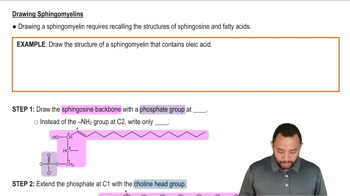
Sphingomyelin is a type of sphingolipid that is a major component of cell membranes, particularly in the myelin sheath of nerve cells. It consists of a sphingosine backbone, a fatty acid, and a phosphocholine group. Understanding its structure is essential for predicting the products of hydrolysis, as the breakdown will yield sphingosine, fatty acids, and phosphoric acid.
Recommended video:
Guided course
3:11
Sphingomyelins Example 2

Complete Hydrolysis

Complete hydrolysis refers to the process of breaking down a compound into its constituent parts by the addition of water. In the context of sphingomyelin, this means fully cleaving all ester bonds to release all fatty acids and other components. This process is significant in biochemistry for understanding how lipids are metabolized and utilized in biological systems.
Recommended video:
Guided course
00:47
Complete Ionic Equations