What is the origin of the triacylglycerols transported by very low-density lipoproteins?
Ch.24 Lipid Metabolism
Chapter 24, Problem 32
How many molecules of acetyl-CoA result from catabolism of 1 molecule of glyceryl trilaurate?
Verified step by step guidance1
Identify the structure of glyceryl trilaurate: It is a triacylglycerol (triglyceride) composed of glycerol and three lauric acid (C12:0) fatty acid chains.
Understand the breakdown process: During catabolism, triacylglycerols are hydrolyzed into one glycerol molecule and three fatty acid molecules. This is catalyzed by lipases.
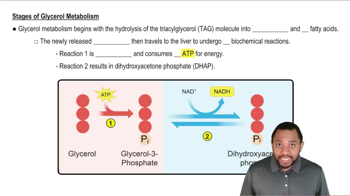
Account for glycerol: Glycerol enters glycolysis and is converted into dihydroxyacetone phosphate (DHAP), which can then proceed through metabolic pathways. However, glycerol does not directly contribute to acetyl-CoA production in this context.
Determine the fate of the fatty acids: Each lauric acid (C12:0) undergoes beta-oxidation. In beta-oxidation, a fatty acid is broken down into acetyl-CoA molecules. For a C12 fatty acid, calculate the number of acetyl-CoA molecules produced using the formula: \( \text{Number of acetyl-CoA} = \frac{\text{Number of carbons in fatty acid}}{2} \).
Combine the results: Since there are three lauric acid molecules, multiply the number of acetyl-CoA molecules produced from one lauric acid by three to find the total number of acetyl-CoA molecules resulting from the catabolism of glyceryl trilaurate.

Verified video answer for a similar problem:
This video solution was recommended by our tutors as helpful for the problem above.
Video duration:
2mWas this helpful?
Key Concepts
Here are the essential concepts you must grasp in order to answer the question correctly.
Glyceryl Trilaurate Structure
Glyceryl trilaurate is a triglyceride composed of glycerol and three lauric acid (C12) fatty acid chains. Understanding its structure is essential for determining how it is metabolized during catabolism, as the breakdown of each fatty acid chain will yield acetyl-CoA molecules, which are crucial for energy production in cellular respiration.
Recommended video:
Guided course
Glycerol Metabolism Concept 2
Beta-Oxidation
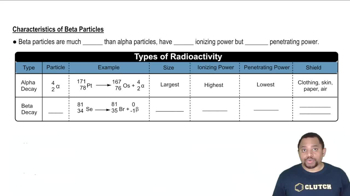
Beta-oxidation is the metabolic process by which fatty acids are broken down in the mitochondria to generate acetyl-CoA. Each cycle of beta-oxidation shortens the fatty acid chain by two carbon atoms, producing one molecule of acetyl-CoA per cycle, which is vital for understanding how many acetyl-CoA molecules are produced from the complete catabolism of glyceryl trilaurate.
Recommended video:
Guided course
Beta Decay Example 1
Glycerol Metabolism
Glycerol, the backbone of triglycerides, can be converted into dihydroxyacetone phosphate (DHAP) and subsequently into glucose or enter glycolysis. This conversion is important when calculating the total yield of acetyl-CoA from glyceryl trilaurate, as it adds to the overall energy output from the catabolism of the triglyceride.
Recommended video:
Guided course
Glycerol Metabolism Concept 2
Related Practice
Textbook Question
924
views
Textbook Question
How is cholesterol transported around the body? When it leaves the liver, what is its destination and use?
573
views
Textbook Question
The glycerol derived from lipolysis of triacylglycerols is converted into glyceraldehyde 3-phosphate, which then enters into step 6 of the glycolysis pathway. What further transformations are necessary to convert glyceraldehyde 3-phosphate into pyruvate?
693
views
Textbook Question
Why is the stepwise oxidation of fatty acids called β oxidation?
1174
views
Textbook Question
How many moles of ATP are produced by the complete oxidation of 1 mol of myristic acid?
891
views
Textbook Question
Arrange these following four molecules in increasing order of their biological energy content (per mole):
a. Sucrose
b. Myristic acid, CH3(CH2)12COOH
c. Glucose
d. Capric acid, CH3(CH2)8COOH
599
views