How is cholesterol transported around the body? When it leaves the liver, what is its destination and use?
Ch.24 Lipid Metabolism
Chapter 24, Problem 39
Why is the stepwise oxidation of fatty acids called β oxidation?
Verified step by step guidance1
The term 'ß oxidation' refers to the specific carbon atom in the fatty acid chain where the oxidation occurs. Fatty acids are long hydrocarbon chains with a carboxylic acid group (-COOH) at one end. The carbon atoms in the chain are labeled using Greek letters, starting with the carbon adjacent to the carboxylic acid group as the alpha (α) carbon, and the next one as the beta (ß) carbon.
In the stepwise oxidation of fatty acids, the process involves the removal of two-carbon units from the fatty acid chain. This occurs through a series of reactions that target the ß carbon, which is the second carbon away from the carboxylic acid group.
The oxidation process begins with the activation of the fatty acid by attaching it to coenzyme A (forming acyl-CoA). This activated fatty acid then undergoes a sequence of reactions, including dehydrogenation, hydration, another dehydrogenation, and finally cleavage, all of which involve the ß carbon.
The key reaction in this process is the formation of a double bond between the alpha (α) and ß carbons, followed by the addition of a hydroxyl group (-OH) to the ß carbon. This is why the process is specifically named ß oxidation, as the ß carbon is the focal point of these chemical changes.
The end result of each cycle of ß oxidation is the production of acetyl-CoA (a two-carbon molecule), which can enter the citric acid cycle for further energy production, and a shortened fatty acid chain that undergoes additional cycles of ß oxidation until it is completely broken down.

Verified video answer for a similar problem:
This video solution was recommended by our tutors as helpful for the problem above.
Video duration:
1mWas this helpful?
Key Concepts
Here are the essential concepts you must grasp in order to answer the question correctly.
Fatty Acid Metabolism
Fatty acid metabolism refers to the biochemical processes that break down fatty acids to produce energy. This process is crucial for maintaining energy homeostasis in the body, especially during periods of fasting or prolonged exercise. Understanding the overall pathway of fatty acid metabolism helps in grasping how ß oxidation fits into the larger context of energy production.
Recommended video:
Guided course
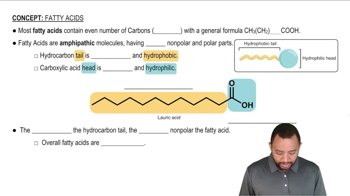
Fatty Acids Concept 1
Beta Oxidation
Beta oxidation is a specific metabolic pathway that involves the sequential removal of two-carbon units from the carboxyl end of fatty acids. This process occurs in the mitochondria and is essential for converting fatty acids into acetyl-CoA, which can then enter the citric acid cycle for energy production. The term 'beta' refers to the position of the carbon atom that is oxidized during the initial steps of this process.
Recommended video:
Guided course
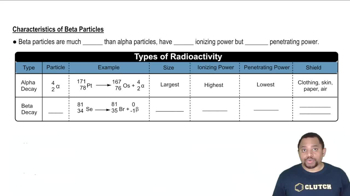
Beta Decay Example 1
Oxidation-Reduction Reactions
Oxidation-reduction (redox) reactions are chemical reactions that involve the transfer of electrons between molecules, leading to changes in their oxidation states. In the context of ß oxidation, these reactions are critical as they facilitate the conversion of fatty acids into energy. Understanding redox reactions is essential for comprehending how energy is extracted from fatty acids during the oxidation process.
Recommended video:
Guided course
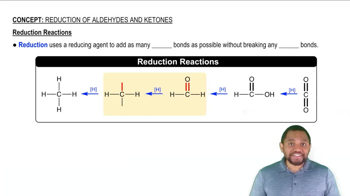
Reduction Reactions Concept 1
Related Practice
Textbook Question
573
views
Textbook Question
The glycerol derived from lipolysis of triacylglycerols is converted into glyceraldehyde 3-phosphate, which then enters into step 6 of the glycolysis pathway. What further transformations are necessary to convert glyceraldehyde 3-phosphate into pyruvate?
693
views
Textbook Question
How many molecules of acetyl-CoA result from catabolism of 1 molecule of glyceryl trilaurate?
499
views
Textbook Question
How many moles of ATP are produced by the complete oxidation of 1 mol of myristic acid?
891
views
Textbook Question
Arrange these following four molecules in increasing order of their biological energy content (per mole):
a. Sucrose
b. Myristic acid, CH3(CH2)12COOH
c. Glucose
d. Capric acid, CH3(CH2)8COOH
599
views
Textbook Question
Show the products of each step in the fatty acid oxidation of hexanoic acid.
a.