Pearson+ LogoPearson+ Logo
Ch.24 Lipid Metabolism
McMurry - Fundamentals of GOB 8th Edition
McMurry8th EditionFundamentals of GOBISBN: 9780134015187Not the one you use?Change textbook
Chapter 24, Problem 28

How is cholesterol transported around the body? When it leaves the liver, what is its destination and use?

Verified step by step guidance
1
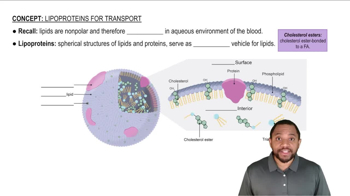
Cholesterol is transported around the body via lipoproteins, which are complexes of lipids and proteins that allow cholesterol to travel through the bloodstream, as cholesterol itself is not water-soluble.
When cholesterol leaves the liver, it is packaged into low-density lipoproteins (LDL) or high-density lipoproteins (HDL), depending on its role and destination.
LDL (often referred to as 'bad cholesterol') transports cholesterol to cells throughout the body where it is used for building cell membranes, producing steroid hormones, and synthesizing vitamin D.
HDL (often referred to as 'good cholesterol') collects excess cholesterol from the bloodstream and tissues and transports it back to the liver for recycling or excretion in bile.
The balance between LDL and HDL levels is crucial for maintaining cardiovascular health, as high levels of LDL can lead to plaque buildup in arteries, while HDL helps remove cholesterol from the bloodstream.

Verified video answer for a similar problem:

This video solution was recommended by our tutors as helpful for the problem above.
Video duration:
4m
Was this helpful?

Key Concepts

Here are the essential concepts you must grasp in order to answer the question correctly.

Cholesterol Transport Mechanisms

Cholesterol is transported in the bloodstream primarily through lipoproteins, which are complexes of lipids and proteins. The main types of lipoproteins involved are low-density lipoproteins (LDL) and high-density lipoproteins (HDL). LDL carries cholesterol from the liver to peripheral tissues, while HDL helps transport excess cholesterol back to the liver for excretion or recycling.
Recommended video:
Guided course
1:39
Lipoproteins for Transport Concept 1

Role of the Liver

The liver plays a crucial role in cholesterol metabolism, synthesizing and regulating cholesterol levels in the body. After cholesterol is produced or absorbed from the diet, it is packaged into lipoproteins and released into the bloodstream. The liver also processes cholesterol for bile production, which aids in digestion and fat absorption.
Recommended video:
Guided course
1:19
Cori Cycle Example 6

Functions of Cholesterol

Cholesterol is essential for various physiological functions, including the formation of cell membranes, synthesis of steroid hormones, and production of bile acids. It contributes to membrane fluidity and stability, allowing cells to function properly. Additionally, cholesterol is a precursor for vitamin D synthesis and plays a role in the body's overall metabolic processes.
Recommended video:
Guided course
02:16
Logarithmic Functions