Pearson+ LogoPearson+ Logo
Ch.24 Lipid Metabolism
McMurry - Fundamentals of GOB 8th Edition
McMurry8th EditionFundamentals of GOBISBN: 9780134015187Not the one you use?Change textbook
Chapter 24, Problem 29

The glycerol derived from lipolysis of triacylglycerols is converted into glyceraldehyde 3-phosphate, which then enters into step 6 of the glycolysis pathway. What further transformations are necessary to convert glyceraldehyde 3-phosphate into pyruvate?

Verified step by step guidance
1
Understand that glyceraldehyde 3-phosphate (G3P) is an intermediate in glycolysis, and its conversion to pyruvate involves several enzymatic steps in the glycolytic pathway.
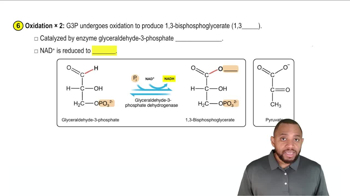
The first transformation involves the oxidation of glyceraldehyde 3-phosphate to 1,3-bisphosphoglycerate. This reaction is catalyzed by the enzyme glyceraldehyde 3-phosphate dehydrogenase, and it requires NAD⁺ as a coenzyme, which is reduced to NADH.
Next, 1,3-bisphosphoglycerate is converted to 3-phosphoglycerate by the enzyme phosphoglycerate kinase. During this step, a molecule of ATP is generated through substrate-level phosphorylation.
The 3-phosphoglycerate is then rearranged to 2-phosphoglycerate by the enzyme phosphoglycerate mutase. This is an isomerization reaction that prepares the molecule for the next step.
Finally, 2-phosphoglycerate is dehydrated by the enzyme enolase to form phosphoenolpyruvate (PEP), which is then converted to pyruvate by the enzyme pyruvate kinase. This last step also generates a molecule of ATP through substrate-level phosphorylation.

Verified video answer for a similar problem:

This video solution was recommended by our tutors as helpful for the problem above.
Video duration:
4m
Was this helpful?

Key Concepts

Here are the essential concepts you must grasp in order to answer the question correctly.

Glycolysis

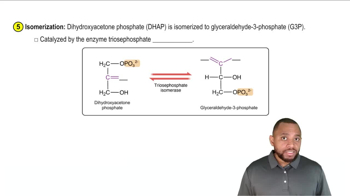
Glycolysis is a metabolic pathway that converts glucose into pyruvate, producing ATP and NADH in the process. It consists of ten enzyme-catalyzed reactions, divided into two phases: the energy investment phase and the energy payoff phase. Glyceraldehyde 3-phosphate (G3P) is an intermediate in this pathway, and its conversion to pyruvate involves several key enzymatic steps.
Recommended video:
Guided course
1:26
Glycolysis Concept 5

Glyceraldehyde 3-Phosphate Dehydrogenase

Glyceraldehyde 3-phosphate dehydrogenase (GAPDH) is an enzyme that catalyzes the conversion of G3P to 1,3-bisphosphoglycerate (1,3-BPG) in glycolysis. This reaction involves the reduction of NAD+ to NADH and the addition of an inorganic phosphate. This step is crucial as it helps in the subsequent production of ATP during the energy payoff phase of glycolysis.
Recommended video:
Guided course
1:44
Glycolysis Concept 7

Substrate-Level Phosphorylation

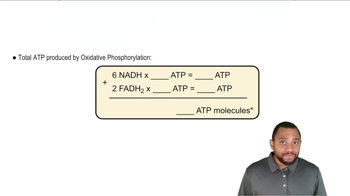
Substrate-level phosphorylation is a process by which ATP is produced directly from the phosphorylation of ADP using a phosphate group from a substrate molecule. In glycolysis, this occurs during the conversion of 1,3-bisphosphoglycerate to 3-phosphoglycerate and again during the conversion of phosphoenolpyruvate to pyruvate. This mechanism is distinct from oxidative phosphorylation, which occurs in the mitochondria.
Recommended video:
Guided course
0:51
Oxidative Phosphorylation Concept 2