Pearson+ LogoPearson+ Logo
Ch.24 Lipid Metabolism
McMurry - Fundamentals of GOB 8th Edition
McMurry8th EditionFundamentals of GOBISBN: 9780134015187Not the one you use?Change textbook
Chapter 24, Problem 12a

Identify each lipoprotein described here as either chylomicron, HDL, LDL, or VLDL.
a. Which lipoprotein has the lowest density? Why?

Verified step by step guidance
1
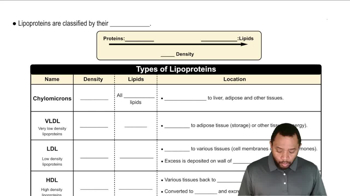
Step 1: Understand the concept of lipoproteins. Lipoproteins are complexes made of lipids and proteins that transport lipids through the bloodstream. They are classified based on their density: chylomicrons, very-low-density lipoproteins (VLDL), low-density lipoproteins (LDL), and high-density lipoproteins (HDL).
Step 2: Recall the relationship between density and lipid/protein content. Lipoproteins with a higher lipid content and lower protein content have lower densities, while those with a higher protein content and lower lipid content have higher densities.
Step 3: Identify the lipoprotein with the lowest density. Chylomicrons have the lowest density because they contain the highest proportion of triglycerides (lipids) and the lowest proportion of proteins.
Step 4: Explain why chylomicrons have the lowest density. The high lipid-to-protein ratio in chylomicrons makes them less dense, as lipids are less dense than proteins.
Step 5: Conclude that the lipoprotein with the lowest density is the chylomicron, and this is due to its high lipid content and low protein content.

Verified video answer for a similar problem:

This video solution was recommended by our tutors as helpful for the problem above.
Video duration:
5m
Was this helpful?

Key Concepts

Here are the essential concepts you must grasp in order to answer the question correctly.

Lipoprotein Classification

Lipoproteins are complexes of lipids and proteins that transport fats through the bloodstream. They are classified into several categories based on their density and composition, including chylomicrons, HDL (high-density lipoprotein), LDL (low-density lipoprotein), and VLDL (very low-density lipoprotein). Each type plays a distinct role in lipid metabolism and cardiovascular health.
Recommended video:
Guided course
3:52
Lipoproteins for Transport Concept 2

Density of Lipoproteins

The density of lipoproteins is determined by their lipid-to-protein ratio. Chylomicrons have the lowest density because they contain a high proportion of triglycerides and a relatively low amount of protein. In contrast, HDL has the highest density due to its higher protein content, which is crucial for its role in reverse cholesterol transport.
Recommended video:
Guided course
3:52
Lipoproteins for Transport Concept 2

Role of Chylomicrons

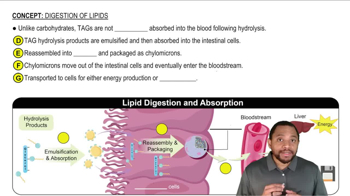
Chylomicrons are lipoproteins formed in the intestines after the ingestion of dietary fats. They transport triglycerides and cholesterol from the intestines to other tissues in the body. Due to their large size and high triglyceride content, they are the least dense lipoproteins, making them essential for the initial transport of dietary lipids.
Recommended video:
Guided course
2:48
Digestion of Lipids Concept 1