Pearson+ LogoPearson+ Logo
Ch.24 Lipid Metabolism
McMurry - Fundamentals of GOB 8th Edition
McMurry8th EditionFundamentals of GOBISBN: 9780134015187Not the one you use?Change textbook
Chapter 24, Problem 47a

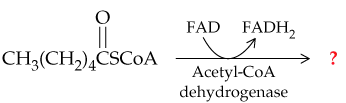
Show the products of each step in the fatty acid oxidation of hexanoic acid.
a. Chemical structure of hexanoic acid with reaction pathway showing Acetyl-CoA dehydrogenase and FAD/FADH2 involvement.

Verified step by step guidance
1
Step 1: Understand the process of fatty acid oxidation (beta-oxidation). Beta-oxidation is a metabolic process where fatty acids are broken down in the mitochondria to generate acetyl-CoA, NADH, and FADH2. Each cycle of beta-oxidation removes a two-carbon unit from the fatty acid chain in the form of acetyl-CoA.
Step 2: Activate hexanoic acid (C6H12O2) by converting it into its CoA derivative. This involves the reaction of hexanoic acid with coenzyme A (CoA) in the presence of ATP, forming hexanoyl-CoA. The reaction can be represented as: Hexanoic-acid+CoA+ATPHexanoyl-CoA+AMP+PPi.
Step 3: Perform the first step of beta-oxidation, which is the oxidation of hexanoyl-CoA. This step involves the removal of two hydrogen atoms from the beta and alpha carbons of the fatty acid chain, forming a double bond. The enzyme acyl-CoA dehydrogenase catalyzes this reaction, and FAD is reduced to FADH2.
Step 4: Hydrate the double bond formed in the previous step. The enzyme enoyl-CoA hydratase adds a molecule of water across the double bond, converting it into a hydroxyl group on the beta carbon and a single bond between the alpha and beta carbons.
Step 5: Continue the beta-oxidation cycle by oxidizing the hydroxyl group on the beta carbon to a keto group using the enzyme beta-hydroxyacyl-CoA dehydrogenase. NAD+ is reduced to NADH in this step. Finally, the beta-ketoacyl-CoA is cleaved by thiolase, releasing acetyl-CoA and a shortened fatty acyl-CoA (now with four carbons, butyryl-CoA). Repeat the cycle until the fatty acid is completely broken down into acetyl-CoA units.

Verified video answer for a similar problem:

This video solution was recommended by our tutors as helpful for the problem above.
Video duration:
1m
Was this helpful?

Key Concepts

Here are the essential concepts you must grasp in order to answer the question correctly.

Fatty Acid Oxidation

Fatty acid oxidation is a metabolic process where fatty acids are broken down to generate energy. This process occurs primarily in the mitochondria and involves several steps, including activation, transport into the mitochondria, and beta-oxidation, where fatty acids are converted into acetyl-CoA units. Each cycle of beta-oxidation shortens the fatty acid chain by two carbon atoms, producing NADH and FADH2, which are crucial for ATP production.
Recommended video:
Guided course
1:29
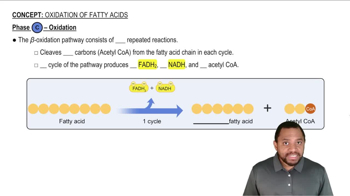
Oxidation of Fatty Acids Concept 3

Hexanoic Acid

Hexanoic acid, also known as caprylic acid, is a medium-chain fatty acid with six carbon atoms. It is significant in metabolism because it can be rapidly oxidized for energy compared to long-chain fatty acids. Understanding its structure and properties is essential for analyzing its oxidation pathway, as the length of the carbon chain influences the enzymes and processes involved in its breakdown.
Recommended video:
Guided course
2:26
IUPAC Rules for Naming Carboxylic Acids Example 1

Beta-Oxidation Pathway

The beta-oxidation pathway is a series of enzymatic reactions that degrade fatty acids into acetyl-CoA units. Each cycle of beta-oxidation involves four main steps: oxidation, hydration, another oxidation, and thiolysis. For hexanoic acid, this pathway will yield three cycles of beta-oxidation, producing two molecules of acetyl-CoA and generating reducing equivalents in the form of NADH and FADH2, which are vital for ATP synthesis in the electron transport chain.
Recommended video:
Guided course
01:26
Beta Decay Example 1